GPT-6 Astra: the model that no longer guesses


We got GPT-6 before GTA 6. And this one changed the way I work.
I tested it all day since it came out. Not for flashy 3D demos, but for real stuff: deploying agents, producing content, checking data. The finding is brutal. The leap is not where everyone is looking.
What actually changed: not intelligence, reliability
Look at how the benchmarks have been covered for the last 48 hours. Everyone talks about a "quantum leap" in math, reasoning, coding. It's true, the numbers are there. But the real change, the one that decides whether this AI ends up inside a small business or not, is elsewhere.
Astra does not guess.
That's the sentence to remember from this entire article. When an AI model looks for instructions and can't find them, it has two options. Either it makes things up, or it stops. Every model we knew made things up. Astra pauses its work when it can't do the job properly.
Sounds trivial. It's actually a complete shift in the working relationship.
I spent years fixing agents that had "done their best". They hallucinated a number, produced a broken interface, then cheerfully told me everything was perfect when I pointed out a problem. That loop, where the AI says "you're right" five times in a row without ever actually fixing anything, is exactly what destroys trust in automation.
Astra breaks that pattern. On a real-world automation benchmark run by Zapier, the previous model from OpenAI (GPT-5.6 Sol) earned partial points by guessing. Astra gave up on the task because it couldn't find the instruction. And that's a good outcome, not a failure. Because the day you automate a business process, you strongly prefer an agent that says "I'm stuck, I'm missing information" over an agent that fabricates a wrong number and presents it with confidence.
Scoop: the exact opposite behavior from everything we accepted until now.
What I verified myself, on real builds
I like to give a model the same brief, under the same conditions, with no retouching. I ran two builds on GPT-6 Astra and on its predecessor GPT-5.6 Sol: an interactive solar system in a standalone HTML page, then a 3D house where you can change the light, the roof and the materials.
Astra took about twice as long and cost three times more. And visually, there's no comparison. The solar system was cleaner, more polished, more alive. The house was actually usable: you changed the facade, switched to dusk mode, removed the roof, read the floor area, the bedrooms, the terrace. Sol's result was pretty without really making sense inside. Even on a brief at this level, I was surprised a model would miss the first version that badly.
What impressed me most wasn't even the result. It's the way it works. Astra can go back through its own prototypes, spot a problem, fix it, judge whether it's solved, then move on. It manages its own improvement loops instead of you having to loop for it.
The self-checking loop
The second change is a natural continuation. Astra doesn't produce and move on. It verifies.
Concretely, when it develops, it opens a browser by itself to test its features. It clicks the buttons a user would click. It inspects the console, looks for errors, detects race conditions, reloads the page. That QA work that teams did by hand at every release, it does it internally before handing you the result.
One developer described it in simple words: the best one-shot model he has ever seen. One-shot means giving a single instruction and getting a finished result, with no iteration or correction from you. For years that was a myth. Astra does it repeatedly because it self-corrects with computer use.
The result: for the first time, a model can not only produce, but also check its own production. And when it checks its own production, it can improve it in a loop without a human following behind.
The numbers, and above all the price per result
Let's talk numbers. Because here too, there's a reading trap.
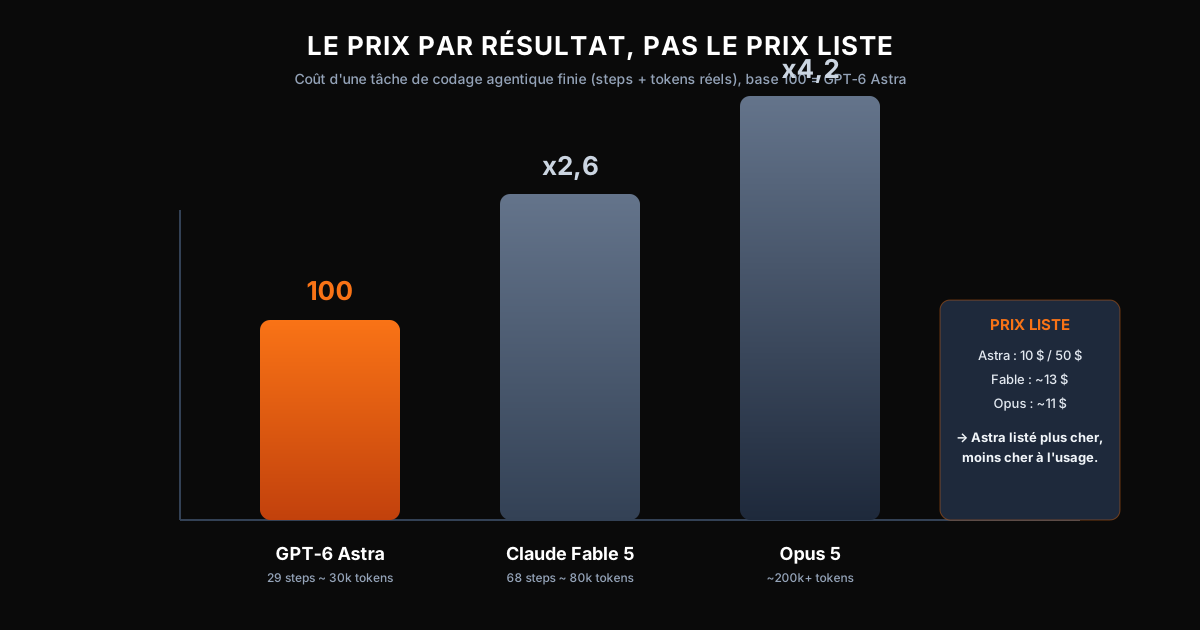
GPT-6 Astra officially costs $10 per million input tokens and $50 per million output tokens. That's 2.5 times more than GPT-5.6 Sol ($4 / $20). On paper, that shocks. In real life, the final bill tells another story.
| Model | List price | Steps (Terminal Bench) | Output tokens | Time/task | Verdict |
|---|---|---|---|---|---|
| GPT-6 Astra | $10 / $50 | 29 | ~30,000 | ~4 min | It optimizes |
| Claude Fable 5 | ~$13 | 68 | ~80,000 | ~9.5 min | Twice the work for half the output |
| Opus 5 | ~$11 | very high | ~200,000+ | slow | Burns tokens |
On the agentic coding benchmark, Astra does a task in 29 steps where Fable needed 68. Almost three times fewer output tokens for a comparable result. Average time per task drops from 9.5 minutes to 4 minutes. Astra uses on average 10 times fewer tokens than Fable and 42 times fewer than Opus 5.
In plain English: the list price is higher, but the price per result is lower. And that's the only measure that matters when you automate a process.
Rule to remember: never look at a model's list price. Look at the price per finished task.
Now some specific benchmarks, because they reveal the real strengths.
| Benchmark | Astra | What it means |
|---|---|---|
| Hard math | 97.6 | Sol was at 83. Big step. |
| Automation Bench (real tasks) | 41.4 | Sol at 18.1. Double, on concrete work. |
| Terminal Bench | 58% | First place, at half the price of Fable. |
| ARC (reasoning) | ~100% | "It's over", testers say. |
| Agent Last Exam | $7.28 | Fable cost $28 for the same test. |
Two honest caveats before we continue. OpenAI itself has raised the possibility of benchmark poisoning. Scores are a direction, not an absolute truth. And in this ecosystem, nothing holds for more than 48 hours: Fable 5.1 was the best model in the world three days ago, Astra dethroned it the next day. The race is crazy, which is exactly why you think in price per result rather than fan club.
What it enables in practice: twenty real use cases
The real substance is the use cases. I collected about twenty documented examples, tested by serious people, all reproducible. I sorted them not by "wow" effect but by job, because that's how you'll use them.
For marketing and content
- Clean educational video. A single prompt produced a 5-minute educational video, with no visible artifacts, no obvious "AI look" that kills credibility. That's the threshold that makes content publishable as is. Great for training, product explainers, demo sequences.
- Writing. Very demanding people on style (daily writers) describe it as the best writing model they've ever tried: fast, little filler, and above all easy to steer. It follows the brief. It doesn't write "its own thing" while ignoring yours. If you produce emails, proposals, articles, that's the quality that matters.
- Presentations. Based on a reference file, it reproduces a near-identical deck. Inside PowerPoint, it becomes an assistant that respects your visual brand. If your team spends hours on slides, you know what that's worth.
For admin, finance and verification
- Document auditing. On a test with 41 financial documents and deliberately hidden errors, it found all 4 errors. The accounting provider announced nearly 40% progress on that specific test. On a corpus of 10 financial models, it coordinated 55 sub-agents to check and correct everything.
- Compliance review. On an NDA review against the company's own contracting policy, the score jumps from 69% to 93%. And crucially, it cites the exact clause behind its decision. It doesn't just say "not compliant", it shows why, with the precise reference.
- Extraction from your own data. Connected to an inbox, it searched all the hardware invoices bought over time and compared them with current market prices. That pattern is gold: extract knowledge from your internal data, then confront it with reality. How much is sleeping in your emails, your files, your history?
For quality, support and internal tools
- Automated QA. A browser-based quality control run went on for over an hour, clicking every button, testing every user path, inspecting the console for errors, looking for race conditions. A human would never have done this with that regularity, and above all wouldn't have documented every step.
- Video editing. Inside Final Cut Pro, it imported files, did color grading, synced multi-camera shots, and even identified the best audio track among several, deleting the others. Repetitive tasks that teams do by hand every week.
- Custom business apps. A scientific app measuring immunology data, that labs paid thousands or tens of thousands of dollars in subscriptions for: a usable version came out of a series of requests. The pattern applies to any specific internal tool in your company.
The spectacle (because it counts too)
It would be dishonest not to mention what went around the web. An entire world with 600 autonomous characters who talk, plan, survive. A fully playable Sim City-like city with emergency management. A Van Gogh painting turned into a traversable 3D world. The reconstruction of a San Francisco landmark in Blender with the right number of fingers. A Minority Report-style interface controlled by hand to run a Mac. And a record: Pokémon completed in 18 hours, when a human takes 25 to 35 hours. That's the first time an AI finished a game faster than a human player.
These demos are spectacular and largely useless on a daily basis for a small business. But they say one thing: the ceiling is much higher than we thought. What was a wobbly proof of concept six months ago has become a finished product. Every time that threshold is crossed, concrete uses emerge in the following weeks.
The limits, and why they reassure me
A good test also includes a failed test. Astra has holes. It produced a frankly ugly Gmail clone (rated 0/10 by testers). It misses some landing pages when you expect a faithful reproduction. On pure frontend, Gemini stays better. On the aggregate coding agent index, Opus stays ahead. And long projects (a personal wiki built over 5 days, an estimated ~$5,000 of tokens) demand a budget a small business won't casually commit.
Those limits are not a problem. They're actually good news. A model that succeeds at everything all the time is a model you can't criticize, and therefore can't really contain. Astra has a clear scope: it excels when there's an instruction to apply, a verification to run, a process to maintain. That's exactly the territory of business agents.
Yes, but it's expensive, and who gets access?
Two objections you're surely raising. The price first: $10 per million input tokens, $50 per million output. The previous model ran at $4 / $20. On a monthly subscription, it translates far more gently than what I just wrote, because the bill also depends on the number of iterations and the reasoning level. Well tuned, an entire project runs for a few dozen dollars. The real bad deal is not that Astra is expensive, it's paying an expensive model for a result a small model would deliver just as well.
Then, who gets access: ChatGPT Plus, Pro, Business and Enterprise plans, plus the API platform and dev tools like Codex and Work. Free ChatGPT doesn't have it. That's the normal behavior of frontier models: you don't put an engine at this price in front of a million free users. For a small business, the path is simple: a Pro or Business subscription for the team, the API for automated processes.
One mention that deserves its own paragraph: cybersecurity. Astra is the first model to reach the "critical" threshold in security evaluations. With the right tools, it can find unknown vulnerabilities (zero-day flaws) and develop an exploit without human guidance at every step. That takes hours and very specific conditions (29 hours to breach a browser, in ultra mode). The useful information for you is elsewhere: OpenAI also presents it as the most aligned model ever released, the one that best respects the limits you set. High alignment and exceptional capability are precisely why public access is locked down compared to internal capabilities. That's normal, and rather reassuring.
The six tips to get the most out of it
- Show it the expected result. Instead of describing what you want, give it an example, a reference file, an image of the target output. It is excellent at reverse-engineering a target. You'll be surprised by the first pass.
- Force it to ask questions before coding. Tell it explicitly to clarify whatever isn't defined before starting. That discipline transforms its output.
- Ask for a verification page. For visual or architectural work, have it produce an HTML page showing the intended result first, before building everything. You validate the direction without burning tokens.
- Dial the reasoning level. Level low is enough for a huge number of tasks. Medium gives what you used to get at max effort on the previous model. High is for hard problems. Max is a luxury reserved for critical cases.
- Go light on computer use first. It takes control of your machine and is surprisingly good at it from the very first try. Reserve ultra mode (parallel sub-agents) for big projects, and use the "goal" feature for long tasks. Bonus: it asks questions along the way, so you can redirect work without restarting everything.
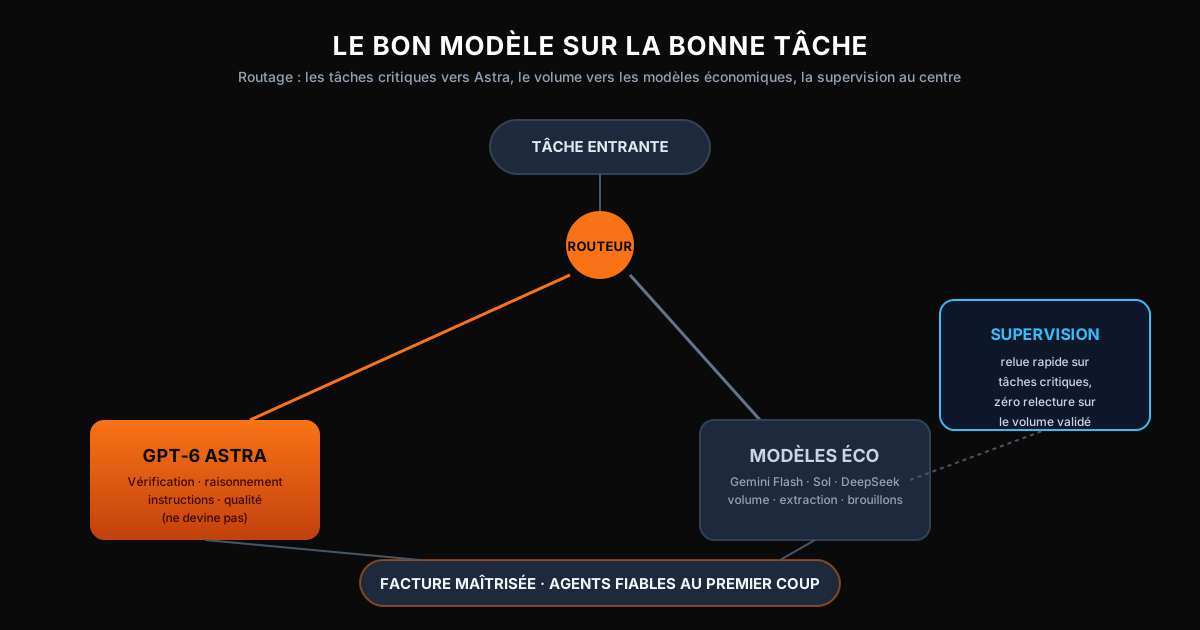
- Don't use it for everything. The classic trap. For volume, an economical model (Gemini Flash, GPT-5.6 Sol, DeepSeek) does the job at a fraction of the cost. You don't fly a fighter jet to buy bread. You're the architect: route the hard tasks to Astra, send the rest to cheap models, and the bill stays under control.
The most telling proof: it ran its own launch campaign
The most striking example of the human/AI repositioning, the one every executive should think about, is the one documented by the team that launched the model.
To run the launch campaign for GPT-6 Astra, they used GPT-6 Astra. The list of tasks it carried looks like a full-time role: building and maintaining the Google Sheets files, creating and updating the communications plan as things moved, drafting pitches to journalists, managing embargoes, tracking replies, preparing press briefings, creating branded PDFs for blog posts, gathering assets from the teams and building press kits, tracking the model's coverage in real time across the web, and producing a summary report of all of it.
What did the human do in that story? He hosted the calls, carried the overall narrative and strategy, made decisions, monitored the situation, and got a full night of sleep.
That's the best illustration of what I've been saying since the start: the frontier has moved. Volume tasks, upkeep, tracking, recurring production are now the machine's work. The human keeps strategy, communication and decisions. And this isn't a concept, it's a real, recent, documented example.
Another signal in the same direction: to track his own costs in use, a heavy user had Astra build an app that aggregates consumption across all his models and subscriptions (a small macOS-style interface, generated in a single pass, showing tokens spent, most-used models, bills per period). He wanted to see where his money went. Same logic as in a business: what you don't measure explodes. Once a tool tells you what each model actually costs on your real tasks, you stop reasoning in theoretical prices and start reasoning in real ones. That's exactly the routing reflex I recommended above.
What it changes for a small business
Here's where I'm going. Because this model won't end up in YouTube demos, it will end up in processes.
For years, the limit of automation wasn't intelligence. It was supervision. An agent produced, a human checked, corrected, revalidated. That supervision cost doubled or tripled the real savings of an automated process.
Astra moves that line. When the model checks its own production, opens a browser to test, stops instead of inventing, human supervision shrinks dramatically. You can hand a real process to an agent without a human following behind every output. That's the real leap for a company: not smarter agents, but agents that are more autonomous without being riskier.
Two safeguards though. Accounts and data stay in your name, in your environment. And on critical tasks (money, compliance, customer), supervision remains, but it becomes a quick review instead of a manufacturing control.
Concretely, today I deploy agents that do what we didn't dare trust them with six months ago: answering prospects reliably, checking financial files, producing publishable content without exhaustive review, testing your own tools before release.
The model that no longer guesses
We spent years accepting an AI that improvised and that we corrected. Astra is the first model of this generation that delivers on the opposite promise: it doesn't guess, it verifies, it stops when it should, and it costs less per result despite a higher displayed price.
The expertise is no longer in choosing the best model. It's in knowing which task to give to which model, and how to frame the work so it's reliable on the first try.
That's exactly what I do: when you hand me your automation, I'm not selling you a model, I build the routing, the safeguards and the processes that let an agent run without a human following behind. And I always start with a free 45-minute audit to see where automation could save you time, before a single euro is spent.
If you want to know what that would look like in your business, let's look at it together.
See also the AI glossary
Browse the full AI glossaryTake action: your Express AI Audit (45 min)
45 minutes with an AI expert to evaluate your operations, identify productivity gains and map your first high-ROI AI agents.
Designed for SME leaders (10 to 100 staff) · No commitment · 100% IP ownership
Deploy AI Agents in your SME with an External CAIO
Get an outsourced AI Director 1 to 10 days per month to audit, automate your workflows and train your teams.
Stay ahead of AI Innovations
Every week, get a curated selection of our latest articles, case studies, and actionable AI insights directly in your inbox. No spam, 100% value.
Fractional AI Director locations