DeepSeek Harness vs Hermes: why you need both (and shouldn't choose)
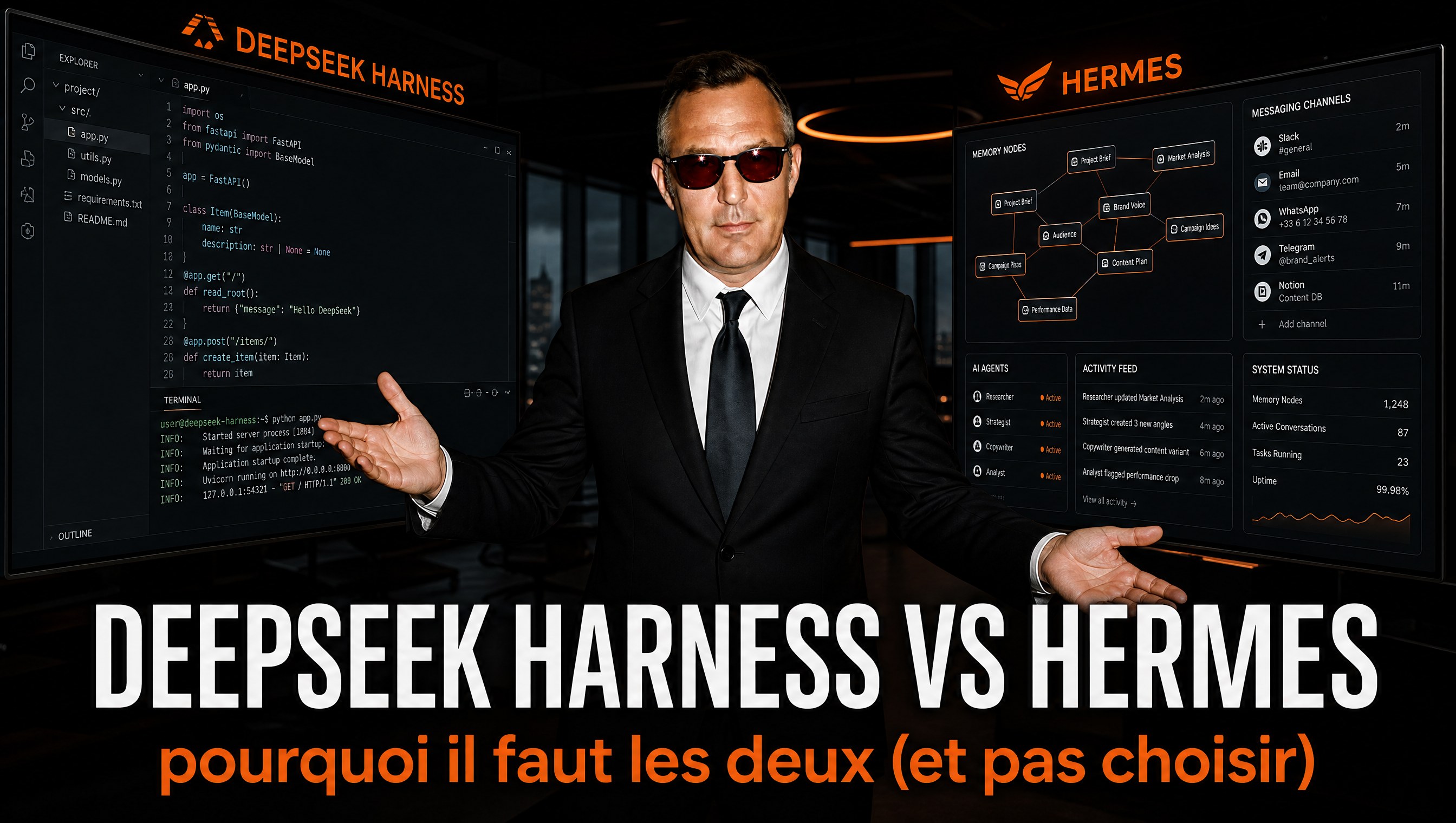
I spent last week bouncing between two AI agents. One builds things in 5 minutes. The other learns from its mistakes and gets faster every run.
The problem is, I started by picking just one. And I lost time.
Here's what I learned about the real question: not "which one is best?" but "how do you put them together?"
The false dilemma
DeepSeek Harness vs Hermes. It's the comparison of the moment in the open source community. But asking "which one?" is like asking "the drill or the hammer?" Both build things. Just not at the same time.
DeepSeek Harness shipped a few days ago. Version 0.1, developer preview. 136,000 GitHub stars in two days. The model behind it, DeepSeek V4 Pro, is a frontier model built specifically for this harness.
Hermes has been around since February 2026. Nous Research behind it. 226,000 stars in six months. The fastest growing open source agent framework of the year, until this week.
They're two different tools solving two different problems. And that's exactly why you need both.
DeepSeek Harness, the builder
The first thing that hits you is the UI. You open the browser, it's a local web page. No desktop app to launch, no extra tab. You already live in the browser, Harness moves in.
The model is a plugin. The tools are plugins. Memory, session locks, search, sub-agents, scheduling. Everything. Even the main loop that makes the agent think is a plugin. You can pull any piece out and replace it without touching the core.
And then there's creator mode. That's where it gets interesting.
You open a session, pick creator mode, and describe what you want. I asked for a daily task scheduler with time slots, days, and repeat options. Result: it designed the day logic, planned the UI, validated the options, and wrote the CSS live. In minutes.
In Hermes, the same class of workflow exists (Hermes Astra, Hermes Muse, Hermes Oracle). Each one took me hours of coding.
Harness is clay. Hermes is concrete once it's set.
What Harness does better
- Coding and building: faster, more reliable, doesn't timeout on big tasks
- Tool creation: creator mode rebuilds the UI in minutes
- Built-in model: DeepSeek V4 Pro is designed for Harness ($0.44 per million input tokens, $0.87 output)
- Simplicity: plain text, easy config, feels like Claude Code
- Flexibility: DeepSeek V4 Flash is free, you can plug in any model
What it doesn't do yet
- No persistent memory between sessions
- No self-improvement loop
- No native messaging channels
- Version 0.1, it will break sometimes
Hermes, the memory
Hermes is the other beast. And where Harness builds fast, Hermes learns.
Three layers of memory. A self-improvement loop. When Hermes solves a problem, it saves what it learned as a skill. Next time the same job comes around, it's faster because it remembers.
Almost no other agent does this.
And then there are the channels. Telegram, WhatsApp, Discord, Microsoft Teams, iMessage. Natively. No plugin to configure, no webhook to set up. You want an alert on your phone? Hermes sends it where you already are.
What Hermes does better
- Memory: three layers + self-improvement = each run is faster
- Messaging: five native channels, zero configuration
- Recurring tasks: research, monitoring, reports, everything that repeats
- Scheduling: cron-style, like other agents
What it doesn't do well
- Big builds: timeout on large coding tasks
- UI: more complex, more noise, longer to get used to
- Model: its own models aren't frontier level
- Desktop only: it's a separate app, another tab to click into
The routing table
Here's the rule I now apply:
| Task type | Tool | Why |
|---|---|---|
| Recurring research (monitoring, reports) | Hermes | Memory makes each run faster |
| Big build or refactor | DeepSeek Harness | Doesn't timeout, much faster |
| Team alerts and approvals | Hermes | Native messaging on five channels |
| Internal tooling (dashboards, scripts) | Harness | Creator mode builds the UI in minutes |
| Cost-sensitive work | Harness | Model is a plugin, DeepSeek V4 Flash is free |
| Long scheduled jobs | Both | Both support cron-style scheduling |
Both tools are free. Open source. And the brain can be free too: plug DeepSeek V4 Flash (free) into both and the bill drops to zero.
The math changes completely. The constraint stops being budget and becomes design.
The solo agent trap
Here's what happened to me. I started with one agent. For everything. Coding, memory, scheduling, alerts. Result: it did two or three things well, and the rest slipped through.
When it times out on a long job, everything downstream never happens. Silently. No error, no alert. Just... nothing.
One agent between a job and a business result is a single point of failure. If it breaks, everything breaks.
The solution: an orchestrator in front. Both agents behind it, each in its lane. The orchestrator routes, logs everything, and keeps the fallback wired in.
Concretely, it looks like this:
- A Hermes agent for daily research (where memory pays off)
- A Harness agent for anything code-related (where speed counts)
- A Hermes channel for human alerts (where the team already is)
- An orchestrator in front so the decision is a rule, not a choice
You don't need to code this orchestrator. Tools like Make, N8N, or a simple script do the job. The important thing is not leaving any agent alone facing the result.
What to take away
DeepSeek Harness is a builder. Hermes is a learner. Both are free. Both run with a free model if you want.
If you have to start with one, start with Harness. It's simpler, breaks less, and you create things fast.
But don't stop there. Add Hermes as soon as you need memory, messaging, or recurring tasks. The combo is bigger than the sum of its parts.
Expertise is no longer in choosing the best tool. It's in distributing the work.
Want to see how this works in your business?
I do a free 45-minute audit where we identify which tasks to automate first, which tool to use, and how to orchestrate it all.
New AI term along the way?
Clear, jargon-free definitions for business leaders.
Take action: your Express AI Audit (45 min)
45 minutes with an AI expert to evaluate your operations, identify productivity gains and map your first high-ROI AI agents.
Designed for SME leaders (10 to 100 staff) · No commitment · 100% IP ownership
Deploy AI Agents in your SME with an External CAIO
Get an outsourced AI Director 1 to 10 days per month to audit, automate your workflows and train your teams.
Stay ahead of AI Innovations
Every week, get a curated selection of our latest articles, case studies, and actionable AI insights directly in your inbox. No spam, 100% value.
Fractional AI Director locations