Home / Blog / Agents & Automation
Best AI Phone Receptionist: 5 Tools Compared in 2026
 Gary Bramnik
14 October 2026 · 10 min read
Contents
Smith.ai: 300 dollars a month for 30 calls. Ruby: 250 dollars a month for 50 minutes. Kylie: 29 euros, one time. Same job, three invoices that have nothing in common.
The AI receptionist market became unreadable in two years. On one side, subscriptions in dollars with volume tiers. On the other, pay-as-you-go credit packs. And in the middle, per-minute pricing that climbs as soon as your prospect starts chatting.
Every competitor promises the same thing: answer 24/7, qualify, book the appointment. If you look at features, you will never decide. If you look at the invoice, you decide in ten minutes.
Here is how I compare the five solutions I checked on October 8, 2026, with no mercy for fuzzy pricing.
The 5 criteria that decide
Before the tools, the scorecard. This is what I use when a client asks me which of the five.
1. Cost of entry. How much you pay to test for two weeks without feeling it. A tool at 300 dollars before you have answered a single call is a tool you will never try. This is the criterion that eliminates half the panel on sight.
2. Pricing model. Flat subscription, credit pack, or per-minute rate. The model decides what you pay on the day you double your volume. That is where most people get burned: they choose on entry price, then discover the "usage" line at the end of the quarter.
3. Answering capacity. Who hangs up on the customer when two calls arrive at once, and can a human take over the line while the prospect is still hot? Two simultaneous calls sound anecdotal until the day of a campaign.
4. End of the funnel: booking and follow-ups. Picking up is nice. Turning a call into a signed slot, with an SMS follow-up behind it, is where the revenue happens. A receptionist who takes a message without taking an appointment is a directory.
5. Traceability. Call notes, objections, recordings, CRM sync. Without it, you are improving your script blind, and you will never know why prospects hang up on your third argument.
The 5 tools, one by one
Kylie AI (ours)
Every model we tried ended up charging us twice: a monthly subscription for access, then a per-minute rate for usage. For a small business taking 30 calls one month and 90 the next, that is impossible to budget.
Kylie runs on credits: 1 credit at about 0.07 euros excluding tax, 1 voice call for 3 credits, 1 SMS for 1 credit. You buy a pack, you consume it, you buy another if you need it. The landing advertises up to 50 simultaneous calls, direct active transfer to a human when the prospect is hot, appointment booking, SMS follow-ups and full traceability with CRM sync.
The packs, prices excluding tax checked on October 8, 2026: Discovery at 29 euros (slashed to "was 58") for 100 credits, Expansion at 139 euros for 500 credits (badge "Popular"), Scale at 249 euros for 1,000 credits. An Enterprise pack exists as a card but its detail is not disclosed.
On the ground it translates into something simple: you plug in your number, you buy a pack, and you watch your consumption move in a dashboard with calls, voicemails and SMS from the last 30 days. Go-live is advertised within 48 hours, no credit card to start, 30-day money-back guarantee.
Strength: the lowest entry cost of the panel and a genuine no-subscription model. Weakness: transparency. The landing shows "No subscription" while its FAQ talks about "139 per month", and the numbers it displays (+35% bookings, 0 missed call) are sourced nowhere.
Sylen (France)
Sylen is the exact opposite of Kylie on the model: a clear monthly subscription, plus a per-minute charge. Start at 49 euros excluding tax per month, Pro at 129, Scale at 329, plus a rate of 0.44 euros the minute dropping to 0.35 as you move up. On annual billing, the three offers read 441, 1,161 and 2,961 euros excluding tax per year.
This is the most readable structure on the market: you know exactly what your floor is every month. For a small business with short, predictable calls, it defends itself well.
The flip side is mechanical: per minute, a conversation that drags costs more than a conversation that goes straight to the point. And if your qualification is poor, you are paying more for a bad call.
Strength: 49 euros entry price and a predictable monthly cost. Weakness: per-minute pricing rewards short calls, not good calls.
AirAgent (France)
AirAgent plays both sides: a monthly subscription with a wide range, and a per-minute rate below Sylen's. Starter at 89 euros a month (71 on annual), Pro at 149, Business at 299, Enterprise at 499, with a minute from 0.21 to 0.30 euros excluding tax depending on the plan, that is a 20% discount if you go annual.
The range is consistent: you can see the path from a small structure to a large one, and going from 89 to 499 euros has no gap. It is the offer that looks most like a classic SaaS subscription, with an Enterprise tier that genuinely exists.
Entry cost is almost twice Sylen's, and nearly three times Kylie's Discovery pack. When you just want to test before committing, you feel it.
Strength: the cheapest minute of the verified French offers, and a complete range. Weakness: subscription plus minute is two lines on the invoice for one single usage.
Smith.ai (United States)
Smith.ai is a US player in this market, and its pricing grid says it: everything is calibrated on call volume. Starter at 300 dollars a month for 30 calls, Basic at 810 for 90 calls, Pro at 2,100 for 300 calls, Enterprise on request.
Unit economics: 10 dollars per call on the entry tier, then around 9 and 7 as you climb. The discount exists, but it is earned: you need to already know how many calls you take to pick a tier, and changing tier means changing contract.
This is the most volume-tested structure of the five: if you take 300 calls a month, there is a tier for you. Below that, you overpay for peace of mind.
Strength: clear volume tiers up to 300 calls, and custom pricing beyond. Weakness: dollar pricing, a 300 dollar entry tier, and a per-call cost that stays high.
Ruby Receptionist (United States)
Ruby sells a different logic: time spent, not call count. Voice at 250 dollars a month for 50 minutes, chat at 143 for 10 conversations, then Voice at 1,725 for 500 minutes and chat at 520 for 50 conversations.
Unit economics: the entry tier comes to 5 dollars the minute. The next tier drops to about 3.45 dollars a minute. It is the most expensive offer of the panel at equal volume, and it is deliberate: Ruby positions a premium service, with a chat channel next to the phone.
For a French small business that simply wants to stop missing calls, jumping from 250 to 1,725 dollars a month is a wall.
Strength: the chat channel on top of the phone, with an accessible entry tier. Weakness: per-minute pricing, the most expensive of this comparison.
The 10-second table
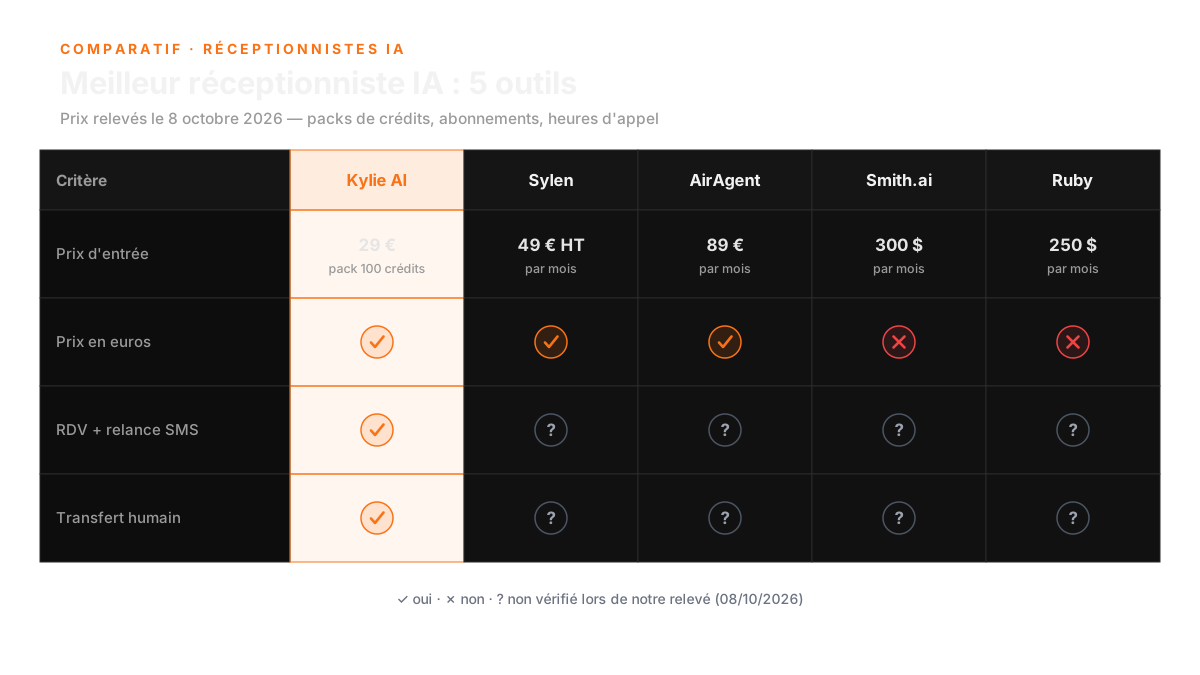
| Criterion | Kylie AI | Sylen | AirAgent | Smith.ai | Ruby |
|---|---|---|---|---|---|
| Entry price | 29 euros (100-credit pack) | 49 euros excl. tax/month | 89 euros/month | 300 dollars/month | 250 dollars/month |
| Model | Credit packs, no subscription | Subscription + minute | Subscription + minute | Subscription by call tier | Subscription by talk time |
| Top tier | 249 euros (1,000 credits), Enterprise not detailed | 329 euros excl. tax/month | 499 euros/month | 2,100 dollars/month (300 calls) | 1,725 dollars/month (500 min) |
| Extra usage billed | No, everything runs on credits | 0.44 to 0.35 euros excl. tax/min | 0.21 to 0.30 euros excl. tax/min | No, call bundle | No, minutes bundle |
| Hot human transfer | Announced (Direct Active Transfer) | Not checked here | Not checked here | Not checked here | Not checked here |
| Booking + SMS follow-up | Yes (booking, SMS, cloned voice) | Not checked here | Not checked here | Not checked here | Not checked here |
| Currency | Euro, prices excl. tax | Euro, prices excl. tax | Euro | Dollar | Dollar |
Prices taken from official pages on October 8, 2026. "Not checked here" means I have no reliable source on that point, not that the tool lacks it.
The honest verdict
Kylie wins on three criteria: the 29 euro entry cost, the no-subscription model that stops you paying a bundle in a month when calls are slow, and the hot human transfer announced natively. On those three, the comparison is not up for debate.
Kylie loses on transparency. Sylen and AirAgent publish a single clean grid, with the per-minute price written in plain sight. We display "No subscription" in one place and "139 per month" in another on the same page, and our Enterprise pack has no price. That is the flaw I would rather own publicly than let a reader discover alone.
And Kylie shares the rest: on booking, on 24/7, on traceability, the challenge is not technical. Every competitor sells the same end of the funnel, with grids that, once translated into euros and real volume, do not tell the same story. That is exactly why I kept a table instead of a list of superlatives: one price, one model, one limit.
The thing I see overlooked most often is the moment volume grows. At 30 calls a month, all the models look alike. At 200, a per-minute subscription or a fixed call tier starts to bite, and that is where the credit model takes the lead back, with no contract to renegotiate.
Scoop: with the same model, the real differentiator is not the AI. It is what you do with the objections logged during calls. Nobody sells that, and yet that is where the productivity gain is won.
FAQ: AI Receptionist Comparison
What are the pricing models for the AI receptionists compared?
The AI receptionists compared use various pricing models: Smith.ai has a monthly subscription, Ruby charges per minute, Kylie operates on a credit system, Sylen has a clear monthly subscription plus per-minute charges, and AirAgent combines both subscription and per-minute rates.
How quickly can I start using Kylie AI?
You can go live with Kylie AI within 48 hours after plugging in your number and purchasing a credit pack. There's no credit card required to start, and they offer a 30-day money-back guarantee.
What features should I consider when choosing an AI receptionist?
Key features to consider include cost of entry, pricing model, answering capacity, booking and follow-up capabilities, and traceability of calls. These factors will help you determine which tool best fits your business needs.
Why we built ours
We built ours because the French market kept handing us two options: subscribe in dollars with a US player, or stack a subscription and a per-minute bill with a local one. In both cases, a small business pays before it has watched a single prospect answer.
Credits are the answer to that exact problem: you commit 29 euros, you look at what comes out, and you decide afterwards. If it does not work for you, the Discovery pack stops there. It is the only model of the five that lets you test without a contract.
We also built ours because we were tired of grids designed for American accounts. A 300-call tier means nothing to a French small business taking 40 calls one month and 120 the next. A dollar price adds a conversion layer, a layer of uncertainty, and a tax question nobody wants to answer before they have tested the tool.
Still, the best AI receptionist in the world cannot fix a badly written script. If your qualification questions ask the wrong thing, the machine will answer perfectly and hand you prospects you cannot serve.
That is exactly where our free audit starts: 45 minutes on your real call volume, your scripts, and a straight answer on whether an AI receptionist serves you or costs you. To see the other agents we built, head to our lab. And to try ours: kylie-ai.fr.
The best tool is the one whose cost you know exactly when the phone rings for real.