Best Team LinkedIn Engagement Tool: 5 Platforms Compared
 Gary Bramnik
19 October 2026 · 11 min read
Contents
PostBeyond lists 1,125 dollars a month for 100 employees. GaggleAMP, EveryoneSocial and Sociabble publish nothing at all: custom quotes. Smarp blocks its pricing page. How do you pick a team LinkedIn engagement tool when half the market refuses to say what it costs?
That is the question we asked ourselves while building Squad-LKN, our own team engagement tool. Spoiler: we are not going to tell you ours wins everywhere. It wins on three criteria, it loses on one, and that loss is written further down.
A market where almost every publisher hides its pricing grid is not competition anymore, it is a disguised auction. You hand over your headcount, they hand you a price, and nobody really knows whether the neighbour is paying the same amount.
The 5 criteria that actually decide
A comparison without criteria is a list of logos. Here are the five we use when a client asks us "what if I bought something else?".
- Is the price published? If you have to talk to a salesperson to know whether you can budget the tool, you already lost three weeks.
- What does it cost for 10 to 50 people? That is the real team size we see among our clients. The 500-seat enterprise rate helps nobody here.
- How fast are you live? A 15-minute setup and a three-month rollout project are not the same tool.
- Who approves before publishing? A comment going out on its own versus passing through human hands changes everything about your reputation.
- Can you try before you pay? The free trial is the only real test of a B2B tool.
Scoop: the team advocacy market is almost entirely "custom quote". Of the four competitors in this comparison, verified on October 8, 2026, exactly one publishes a clear price. The fifth is ours, and it is written further down.
The method, to be straight: direct fetch of the official pricing pages, prices recorded as displayed, original currency kept. Whatever is not published is marked "custom quote" or "not published". We did not round anything in our favour, did not convert anything to make a price look smaller, and invented nothing where the page shows a form instead of a number.
GaggleAMP
GaggleAMP is an established team advocacy platform, sold on a custom quote: pricing is worked out case by case based on headcount, through a contact form. Nothing published, no grid, no calculator, not even an indicative range.
In practice, that means you cannot put GaggleAMP into a budget before a sales meeting, a proposal, and then a negotiation. For a management committee that signs off monthly, that is a delay stacked on top of the deployment delay. Three weeks before you even have the number is three weeks where your team still is not commenting on anything.
The "by headcount" pricing logic is sound: you are not paying a fixed package for a team that keeps growing. But as long as the number stays invisible, the logic stays theoretical. It is like a restaurant that tells you "prices follow the market" on the menu: possibly reasonable, but you do not order without seeing the numbers column.
Strength: pricing scales with your team size. Weakness: you cannot budget it before talking to a salesperson.
PostBeyond
PostBeyond is the only platform in this lineup to publish a real price: 1,125 dollars per month for 100 employees on its Growth plan, which works out to roughly 11 dollars per head per month. Above 250 employees it moves to custom pricing on the Enterprise plan. A 30-day free trial is offered for up to 30 employees.
That is transparent, and in this market transparency deserves to be called out. The flip side: 100 employees is the minimum of the Growth plan. A 15-person team pays the same as a 100-person team, and that is exactly the situation a French SMB hits on day one.
At 50 users, PostBeyond still costs 1,125 $ per month (imposed tier), while Squad-LKN drops to 1,450 € with the published pack. The gap narrows, but the entry point stays heavier: for a team of 15, the difference is 585 € against 1,125 $.
The Enterprise plan above 250 employees is a custom quote, so on the large-account segment PostBeyond joins the club of hidden grids.
Strength: the only published price and the only 30-day free trial in the lineup. Weakness: a 100-employee entry tier, so small teams overpay by default.
EveryoneSocial
EveryoneSocial is an established advocacy platform on the US market, also sold on a custom quote ("price quote" on its pricing page). You leave your email, a salesperson calls back, you get a proposal.
The positioning is clearly enterprise: multinationals, structured internal communications, rollouts run by corporate teams. For a 20-person SMB, it is like calling a caterer for a sandwich.
We are not going to invent its strengths either: the pricing page says nothing more than "ask for a price", and we have no access to its back office. Claiming otherwise would be advertising dressed up as a comparison. That is exactly this market's problem: missing information forces everyone to tell their own version.
Strength: a model proven with large accounts. Weakness: zero public pricing, zero basis for comparison before the meeting.
Sociabble (Poppulo)
Sociabble is the other name our own landing sets against Squad-LKN, with an advertised range of 50 to 100 € per user. An important nuance: that range comes from Squad-LKN's own comparison, not from Sociabble's pricing page, which offers a demo and nothing else.
In other words, Sociabble does not publish its price. The range we display ourselves is indicative, which is exactly why we quoted it so carefully in our own grid. If a competitor ever accuses us of showing 100 € to look like the cheap option, the answer is simple: our sources are public, theirs are not.
This is the market in a nutshell: solid solutions, sold by sales teams, where the final price depends on the conversation, the volume and the negotiation. Nothing dishonest about it, but you are not comparing, you are receiving a proposal.
Strength: a complete solution sold with a demo, so you can see before you buy. Weakness: no public price, so those 50 to 100 € per user cannot be verified before the meeting.
Squad-LKN
Our tool, then. We built Squad-LKN because we were tired of two things: per-user grids at 50 to 100 € that a 15-person SMB cannot absorb, and quotes that take three weeks to arrive. Team LinkedIn engagement does not need an enterprise project, it needs twelve teammates clicking this week.
What the platform does: automatic detection of team posts (hourly cron), in-context AI comments, approval before publication, automatic and semi-automatic modes, gamification with leaderboards and analytics, mobile and desktop apps. Setup advertised at 15 minutes, beta phase with no commitment.
The price is published and dated: Start at 39 € per user per month (10-user pack, 390 € per month), Growth at 29 € per user per month (50-user pack, 1,450 € per month), custom quote above 50 users. Our own reach figures (400%) and engagement figures (800%) are vendor claims with no published methodology: we display them, we do not present them as guarantees.
And to be completely transparent: the comparison on our own landing advertises a 19 € per user floor that does not exist in any pricing card. The real grids show 29 € and 39 €. We write it here because a verdict that does not quote its own flaws is not a verdict.
Strength: the lowest published price in the lineup and human approval before publication. Weakness: no published free trial, and above 50 users we go back to custom quotes like everyone else.
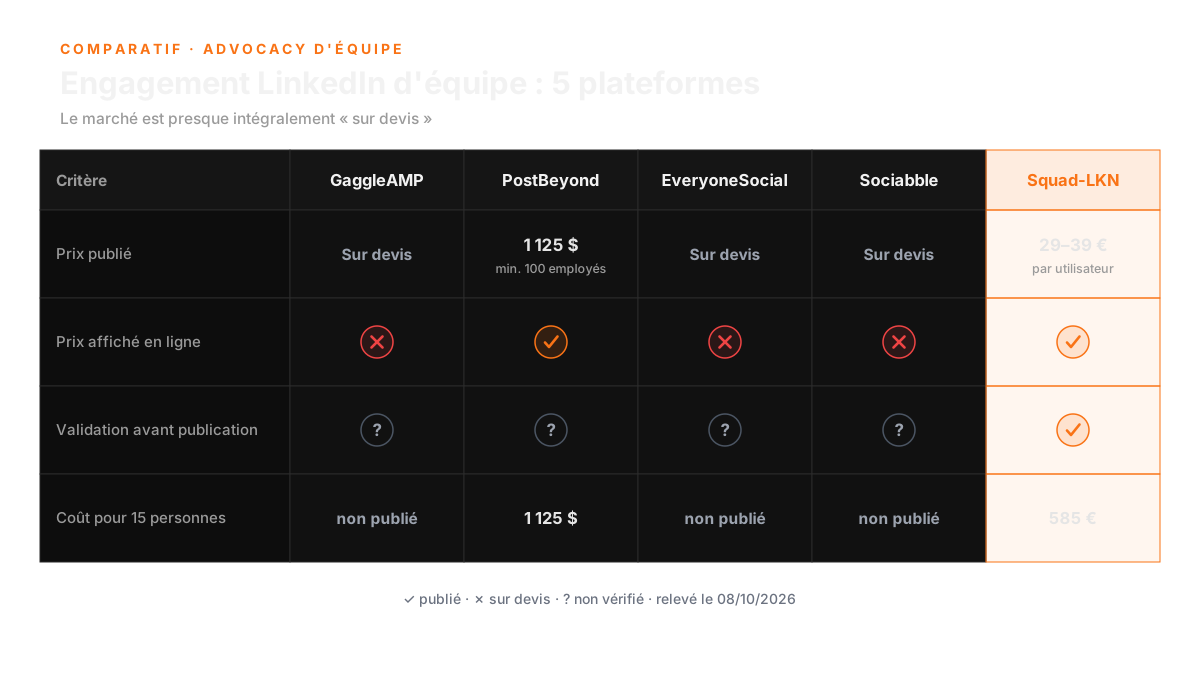
The table, in 10 seconds
| Criterion | GaggleAMP | PostBeyond | EveryoneSocial | Sociabble | Squad-LKN |
|---|---|---|---|---|---|
| Published price | Custom quote | 1,125 $/mo (min. 100 employees) | Custom quote | Custom quote | 29 to 39 €/user |
| Cost for 15 people | Not published | 1,125 $/mo (imposed tier) | Not published | Not published | 585 €/mo |
| Cost for 50 people | Not published | 1,125 $/mo (about 11 $/head) | Not published | Not published | 1,450 €/mo |
| Trial before paying | Not published | Yes, 30 days (up to 30 employees) | Not published | Not published | Not published (beta, no commitment) |
| Approval before publishing | Not verified | Not verified | Not verified | Not verified | Yes, editable comments |
| Announced setup time | Not published | Not published | Not published | Not published | 15 minutes |
Prices taken from official pages on October 8, 2026. "Not verified" does not mean no: it means the official page does not show it. Smarp, the other big name in the sector, is missing from the table: its pricing page returns an HTTP 403, and the only available figures come from third-party sources (from 6 to 8 $ per user, a February 2026 scan), too fragile to be shown as a price.
What the table does not show: the quality of the generated comment, the depth of the analytics, the level of support. On those points, no pricing page answers for you. That is why a trial or a demo beats ten table columns, and that is exactly the criterion we assume we lose.
The verdict, no waffle
On published price and transparency, Squad-LKN wins. We show 29 to 39 € per user, and three of the other four send you to a salesperson. For an SMB that has to get a budget approved in a committee, that is the criterion that decides everything.
On the cost of a 10 to 50 person team, Squad-LKN wins too. 585 € for 15 people, 1,450 € for 50. PostBeyond imposes its 100-employee tier from the start, GaggleAMP, EveryoneSocial and Sociabble publish nothing.
On setup time, Squad-LKN wins. 15 minutes, no commitment. None of the competitors in this lineup publishes a timeline, and the "demo then proposal then negotiation" format is measured in weeks.
On the free trial, we lose. PostBeyond offers 30 days for up to 30 employees. We publish no free trial: we bet on the beta phase without commitment, which is not the same promise. If a free trial is non-negotiable for you, PostBeyond wins this criterion, period.
On large teams, we tie at best. At 100 users PostBeyond shows about 11 $ per head, we are at 29 € per user and on a custom quote above 50. From 100 teammates on, we do not claim to win, and we are not going to compare ourselves to established US enterprise platforms just for show.
Three wins, one loss, one tie. That is an honest score: a comparison where the owner's tool wins everywhere is a press release.
The angle is simple: we built ours because the serious alternatives were out of budget for our SMB clients or asked them to wait for a quote. We did not invent a new market, we just made the existing one accessible.
FAQ: Team LinkedIn Engagement Tools Comparison
Why is it difficult to find pricing information for team LinkedIn engagement tools?
Many tools in the market, like GaggleAMP and EveryoneSocial, operate on a custom quote basis, meaning they do not publish prices upfront. This creates uncertainty for potential buyers who need to budget effectively.
What is the advantage of using PostBeyond?
PostBeyond is the only platform in this comparison that publishes a clear price of 1,125 dollars per month for 100 employees, along with a 30-day free trial for up to 30 employees, providing transparency in a market where most competitors do not.
How does Squad-LKN compare to other tools regarding pricing for smaller teams?
Squad-LKN offers a more favorable pricing model for smaller teams compared to PostBeyond, which charges the same amount regardless of team size. For instance, a team of 15 would pay significantly less with Squad-LKN compared to PostBeyond.
What we suggest you do
Write the team sizes that actually concern you (15, 30, 50) on a sticky note, then call the other four one by one with that number in your hand. You will quickly see who publishes a price and who offers you a demo. Scoop: the answers always come back in the same order.
If you would rather start from the field: apply criterion number 4 to your last company posts. A teammate comment published within 10 minutes is either a responsive human or a system. Either way, it beats three likes from the founders.
We assembled this funnel in our lab, with the usual rules: published pricing, human approval, no end-of-month surprises. The official site is here: squad-lkn.com. And if you want us to look at your situation before any commitment, the free audit is the right starting point.
An honest comparison always ends on the same line: the best tool is the one your team actually uses on Monday morning.