Loop Engineering: the two types of loops that make your AI agents work in production

Prompt Engineering had its moment. For months, the formula seemed simple: write a precise instruction, get a correct result. But in production, this approach shows its limits.
An agent that acts in a silo, without a feedback loop, without the ability to detect and correct its own errors, is not an agent, it's a glorified script.
The real technical breakthrough of 2026 is called Loop Engineering: instead of writing prompts yourself, you design systems that do the prompting for you. You define the end goal. The agent figures out the steps, corrects itself, works around obstacles, and loops until the work is done.
The focus shifts: it's no longer about the quality of your instructions, but the quality of the architecture that orchestrates them.
The two loop families
Not all loops are alike. In production, we distinguish two major categories that address fundamentally different problems.
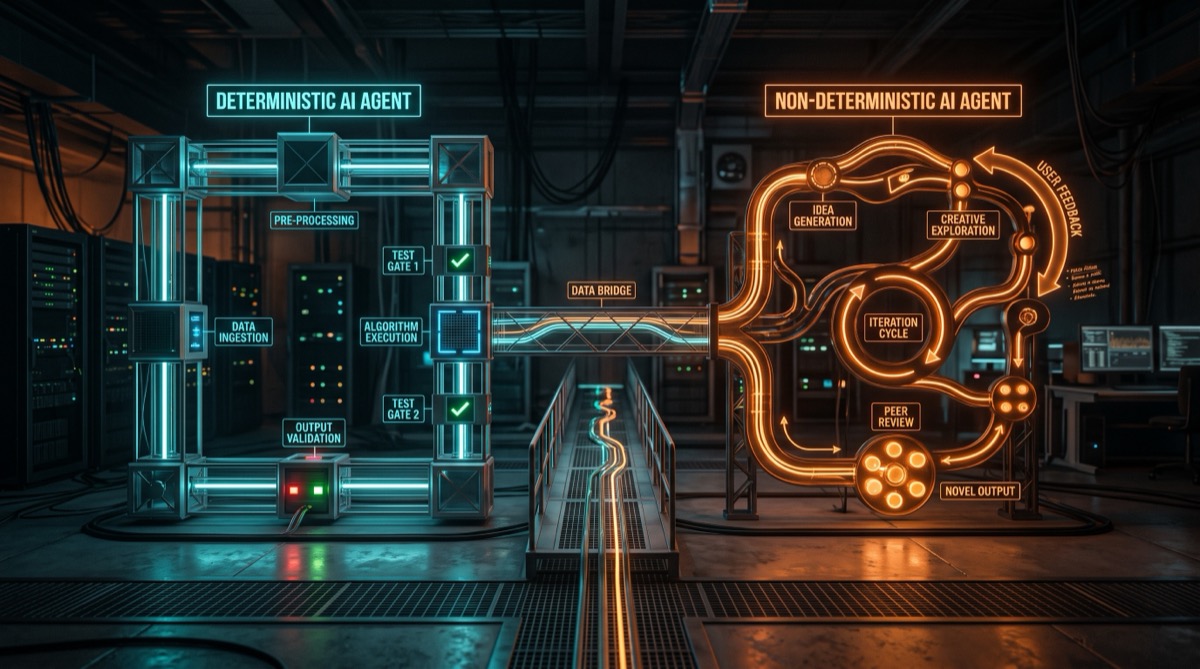
Deterministic loops
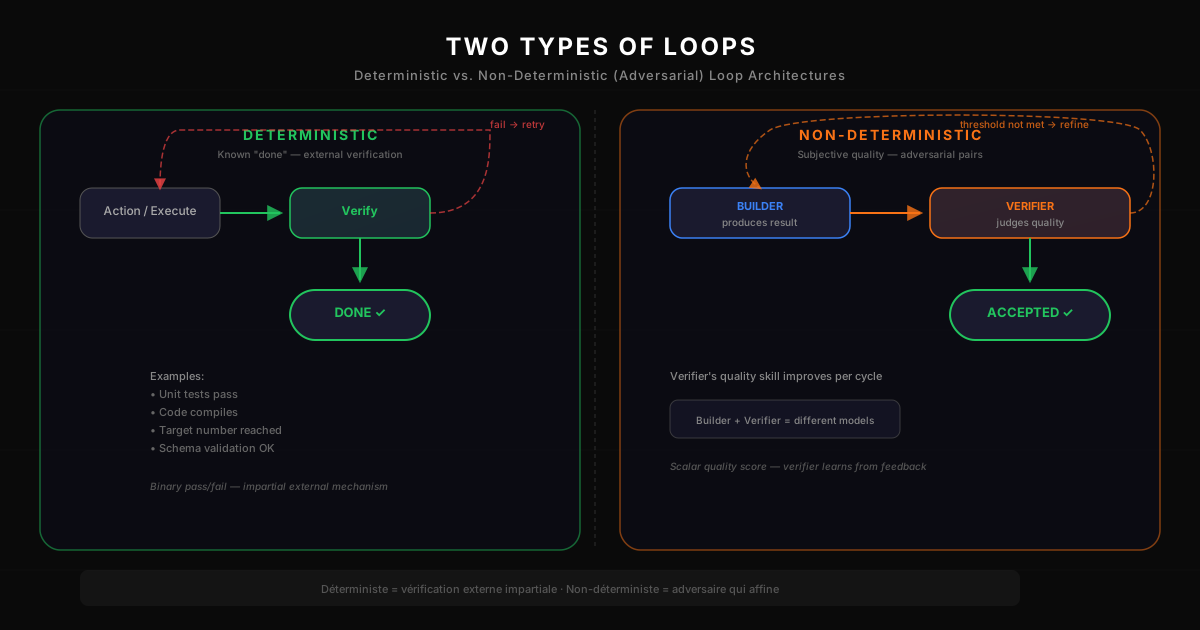
Some tasks have a clear "done" state. Tests pass. Code compiles. A number reaches a target value. Success is measurable by a binary rule: it works or it doesn't.
In a deterministic loop, the agent knows exactly what "done" looks like. It executes an action, checks the result via an external system (test suite, compilation check, validation script), detects failure, fixes, and retries. The cycle stops when all checks pass.
The key is external verification. The agent doesn't decide if its work is good, an impartial mechanism does. Unit tests, linting, schema validation, compliance checks. The stricter the verification, the more reliable the loop.
Non-deterministic loops
But not all tasks lend themselves to automatic verification. How do you objectively test if a user interface is "beautiful"? If a text is "convincing"? If a strategic analysis is "relevant"?
These tasks require human judgment. Or rather: a mechanical approximation of human judgment.
The emerging solution is the adversarial architecture. A builder agent produces the output. A second agent, ideally a different model with complementary strengths, acts as the verifier. The verifier has a "quality detection skill" that improves over time by incorporating feedback from each cycle.
The builder proposes. The verifier opposes. Each iteration refines the result. The loop doesn't stop when a binary rule is satisfied, but when the verifier judges the quality threshold is met.
The 6 components of a well-built loop
A solid loop cannot be improvised. Here are the parts that must be explicitly designed:
1. Context management
What goes into context each turn. The classic trap: initial system prompts get buried under recent tool outputs as the conversation grows. Without cleanup or prioritization, the agent eventually forgets its original mission.
2. Quality feedback
Test outputs, screenshots, error messages, logs, whatever its form, feedback is what the agent reads to decide its next move. The quality of the feedback determines the quality of the correction.
3. Verification gates
Checkpoints that translate feedback into a clear verdict. Verification must be binary or scalar, never ambiguous. "Test passed: true/false" rather than "the result seems correct."
4. Termination condition
The explicit rule that tells the loop to stop. This is the most commonly forgotten element. Without an explicit termination condition, the agent stops too early (because it thinks it's done) or never stops (because it always finds something to improve). Set it at the start of the session: "Stop when tests pass" or "Stop after a maximum of 5 iterations."
5. Error handling
Tool calls fail. APIs timeout. Files are not found. A robust loop specifies what happens in each case: retry, escalate, or cleanly abandon without leaving a broken state.
6. State management
A context window can't hold everything. For long-running tasks, state must be persisted in external files, logs, tracking files, a lightweight database, that the agent reads and writes each cycle. This allows resuming an interrupted session without resetting everything.
The adversarial pattern in practice
The adversarial architecture deserves attention. It's probably the most underestimated pattern in Loop Engineering.
The principle: two agents with complementary personalities. One creative, production-oriented. The other analytical, criticism-oriented. And crucially: different models, to prevent the verifier from reproducing the same blind spots as the builder.
What makes this pattern powerful is that the verifier's detection skill isn't static. Each evaluation cycle teaches it something. If it identifies a new recurring error category, it updates its quality framework. The loop becomes a learning system, not just a simple automaton.
The cost of loops
Let's be direct: loops are expensive in tokens. Each iteration consumes context, API calls, and execution time.
The rule is simple: more tokens available = better results. But that doesn't mean you should loop systematically. Before designing a loop, ask yourself: "Does the quality gain justify the additional cost?"
For a trivial task, a loop is waste. For a client delivery or critical deployment, it's a necessary investment.
Loop Engineering is about choosing your battles, and designing systems that win the ones that matter.
Optimize agent reasoning loops with an Externalized AI Direction
Designing efficient agent loops delivers surgical precision while keeping token costs strictly under control.
Through our Externalized AI Direction, we build your agentic systems:
- Analyzing your needs to select between deterministic and self-correcting reflexive loops.
- Implementing automated verification and quality evaluation frameworks.
- Continuously monitoring inference costs and overall agent performance.
🎁 Access the 1000 Skills Hub
Get our loop architectures and workflows to deploy autonomous agents in production.