Loop Engineering: The Hidden Architecture Behind High-Performance AI Agents


The Problem: You Are Using AI Like a Chatbot
99% of users interact with AI the same way: "You are an expert, give me the best solutions." Result? Generic text, wasted potential, and no real work done.
This is not your fault. Current interfaces naturally push toward this behavior. But modern reasoning models are not glorified chatbots. They are work engines capable of autonomous reasoning loops, like a developer iterating on a problem until it is solved.
The difference? Architecture.
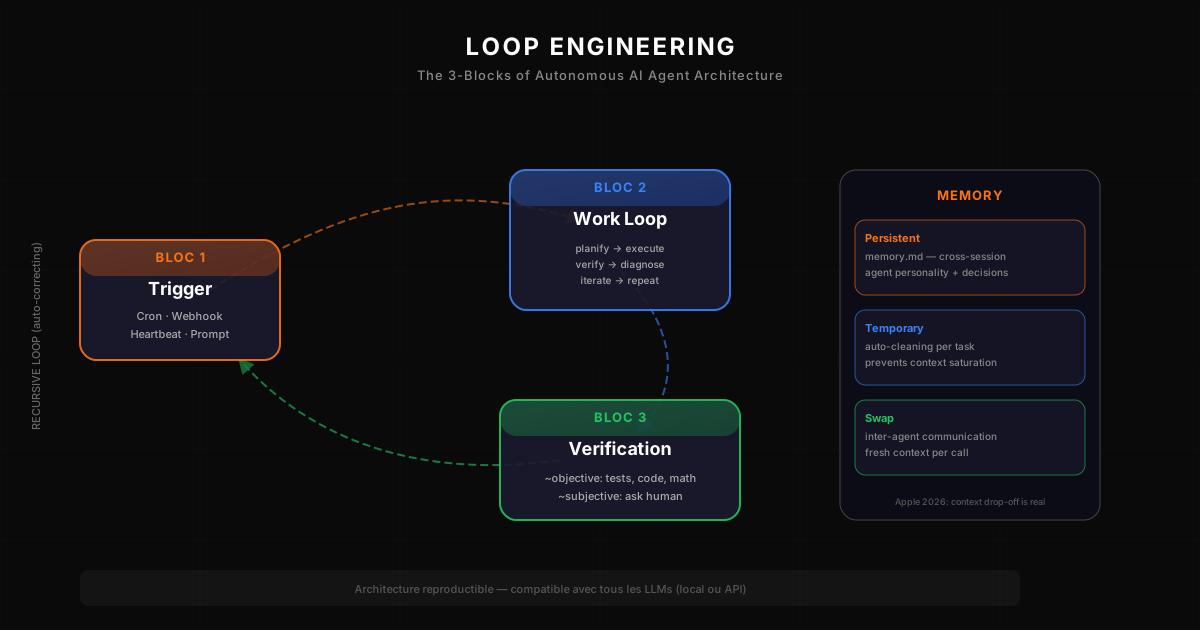
Loop Engineering: The 3 Fundamental Blocks
Loop engineering describes a system where the model does not just respond, it observes, plans, executes, verifies, and retries until a validated goal is reached.
1. The Trigger
Work does not start by itself. A trigger is needed, an event that tells the system "time to act":
- Cron: a scheduled task (every day at 8 AM)
- Webhook: an API call signaling a state change
- Heartbeat: a periodic signal checking system health
- Manual prompt: you start the work yourself
2. The Work Loop
This is the system core. The model:
- Analyzes context and objective
- Plans required steps
- Selects available tools
- Executes the first iteration
- Verifies the result
- Diagnoses gaps
- Iterates until reaching the success threshold
Each iteration is a complete loop. Without guardrails, this system can run indefinitely, your only limit is your token budget.
3. Verification
The most fragile point. How does the AI know it reached its goal?
Two types of verification exist:
Objective verification: code compiles, tests pass, math formulas are correct. Models excel here as they have built-in test batteries.
Subjective verification: an analysis report, a marketing strategy, a tax optimization. The model cannot verify what is "good" because it lacks access to market reality or human context.
The solution: define explicit proof thresholds. If the model cannot determine an objective criterion, it should ask you: "What tests should I run to validate this work?"
The Inflection Trap
Every session has a hidden limit: the inflection point. As the session progresses, context fills up, and model performance drops drastically. Studies show that beyond a certain threshold, the model stops producing useful work and just burns tokens in loops.
The workaround? Do not give everything to the same model in the same session.
The 3-Level Memory Architecture
To avoid inflection, manage memory like an operating system:
Persistent memory (memory.md): stores decisions, preferences, cross-session learning. This is the agent's "personality."
Temporary memory (self-cleaning): used only for the current task's steps. Once the task is done, it is erased. This avoids accumulating useless context.
Swap memory: allows multiple agents to communicate. Each agent has its own context window, but they share a swap zone to pass relevant information.
This architecture reproduces the "separate processing windows" mechanism that top models use internally. By calling functions in fresh contexts, you avoid contamination from previous session probabilities.
Skills and Routing: Do Not Put Everything in One File
An agent should not contain all its knowledge in a single file. The right approach: an orchestrator (agent.md) that routes to specialized skills (skill.md).
Each skill contains the specific process for a given task, associated scripts, assets and references, and a short description. The agent checks the skill description, and only if it matches the current task, it loads the full instructions. This enables on-demand context injection at the right moment.
Transportable and Autonomous Agents
The end goal: an agent that works without an API key, can be moved from one computer to another, and runs with any model (local or remote). By making the LLM the backend of the interface rather than a simple client, the agent launches its own server in the background, processes requests locally, and only needs the model subscription.
A concrete example: an email sorting agent that processes 200 messages in 15 seconds, connected to your accounts via MCP, with a self-learning classification algorithm. When in doubt, it asks for validation (HITL Review). You give it a rule, it adds it to its knowledge base, and next time it handles that case on its own.
Copy the Architecture, Not the Model
The real lesson: you do not need to pay $50 per million tokens to benefit from loop engineering. The architecture is reproducible. By structuring your agents with:
- An orchestrator with routing
- 3-level memory
- Specialized skills loaded on demand
- Explicit verification thresholds
- Rollback and stagnation detection
...you can apply the same logic to models 10 to 20 times cheaper. The power does not come from the model, but from the structure it operates within.
Want to build your own agents with this architecture? Our AI Skills Hub contains ready-to-use templates for structuring your agents with reasoning loops, memory, and routing, compatible with all LLM models.
Build robust agent architectures with an Externalized AI Direction
Orchestrating autonomous agent loops is what separates a fragile AI demo from an enterprise system running 24/7.
Through our Externalized AI Direction, we design your custom architecture:
- Implementing planning, execution, and quality-control loops.
- Embedding guardrails to stop execution in case of anomalies or budget overruns.
- Regular performance monitoring and seamless adaptation to tech updates.
🎁 Agent Templates with Loop Engineering
Get 3 ready-to-use agent templates with memory architecture, routing, and verification loops.