AI: $50 trillion promised, and in the meantime?
 Gary Bramnik
21 October 2026 · 8 min read
Contents
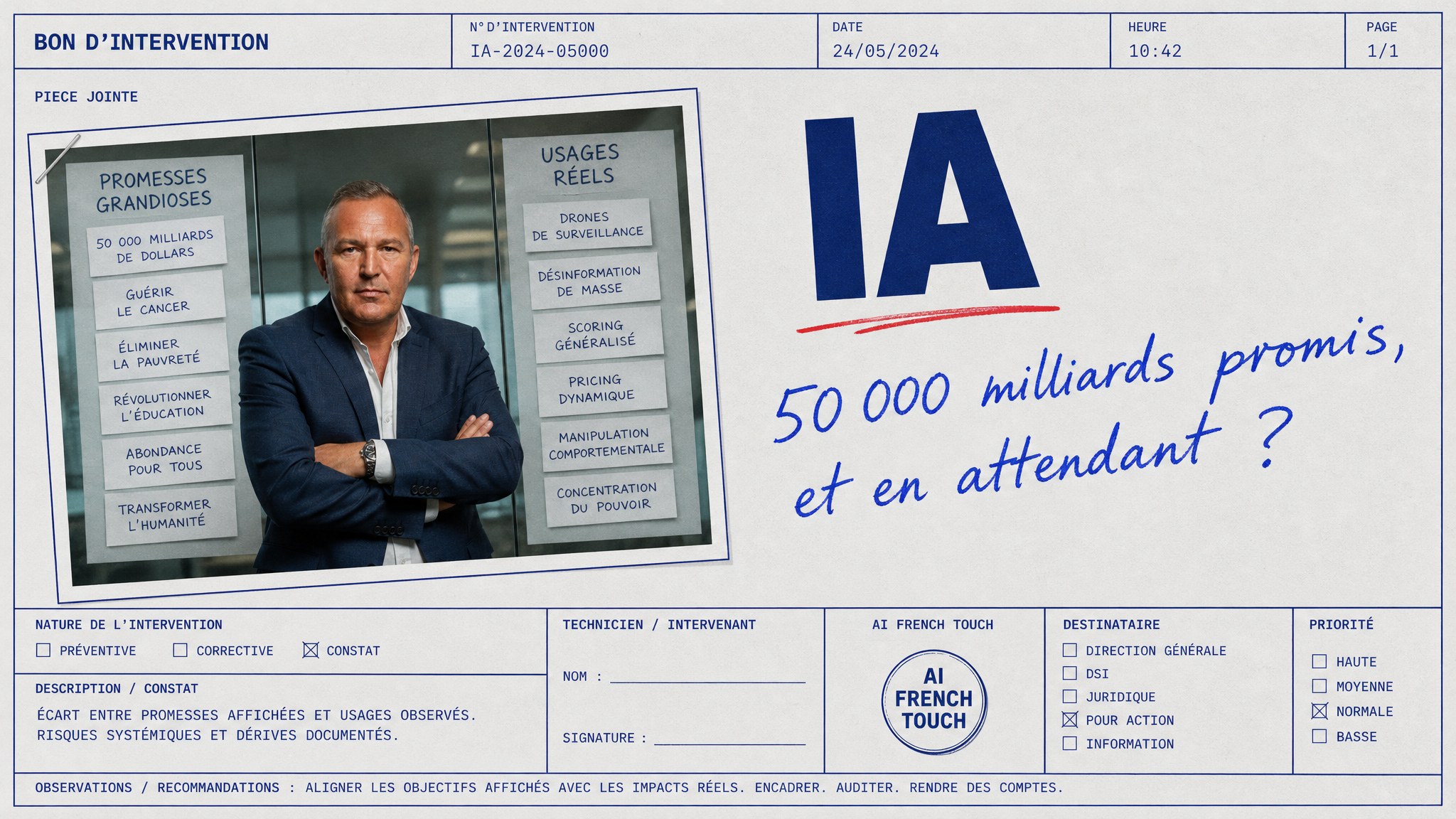
The promoters of artificial intelligence promise an age of abundance. But when you ask what we get in exchange for the risks, the answer is remarkably blurry. Between distant promises and today's very real uses, the gap deserves a close look. Here are the questions worth asking, and what the answers given so far are actually worth.
A market for suckers?
The price to pay comes first: estimates cited in the debate put the risk of human extinction between 10 and 25%. On the other side, here is what AI's promoters put on the table (original remarks):
"Access to world-class healthcare and education, and much more. Fighting climate change will eliminate poverty, solve diseases, cure major diseases like cancer and Alzheimer's."
The common-sense question is the one any buyer would ask: wow, that's great, and when do we get it? The answer given:
"One day, we will be far more capable. One day. And it will be soon."
One day, soon: no date, no commitment. In a commercial negotiation, a counterparty without a deadline is called a promise, not a contract.
Me, I can't wait to get there, to that famous day in the future. And frankly, I'm starting to feel like we're being fed bullshit.
What AI actually does today
The contrast with the present is striking. While we talk about cured diseases, I ask a question out of pure curiosity: what do we actually use AI for right now? Here are the uses its critics already denounce:
- AI-driven drone swarms helping US immigration police (ICE) track down immigrants;
- the spread of disinformation to influence democracy;
- the design of weapons and attack plans, operational targeting, cyberattacks;
- mass surveillance systems;
- dynamic pricing tools, with McDonald's pushing AI tools to raise prices based on demand.
Let's recap: tomorrow we will use AI to cure diseases, but for now it's mostly murder, surveillance, and a price hike on the McRib. What a deal!
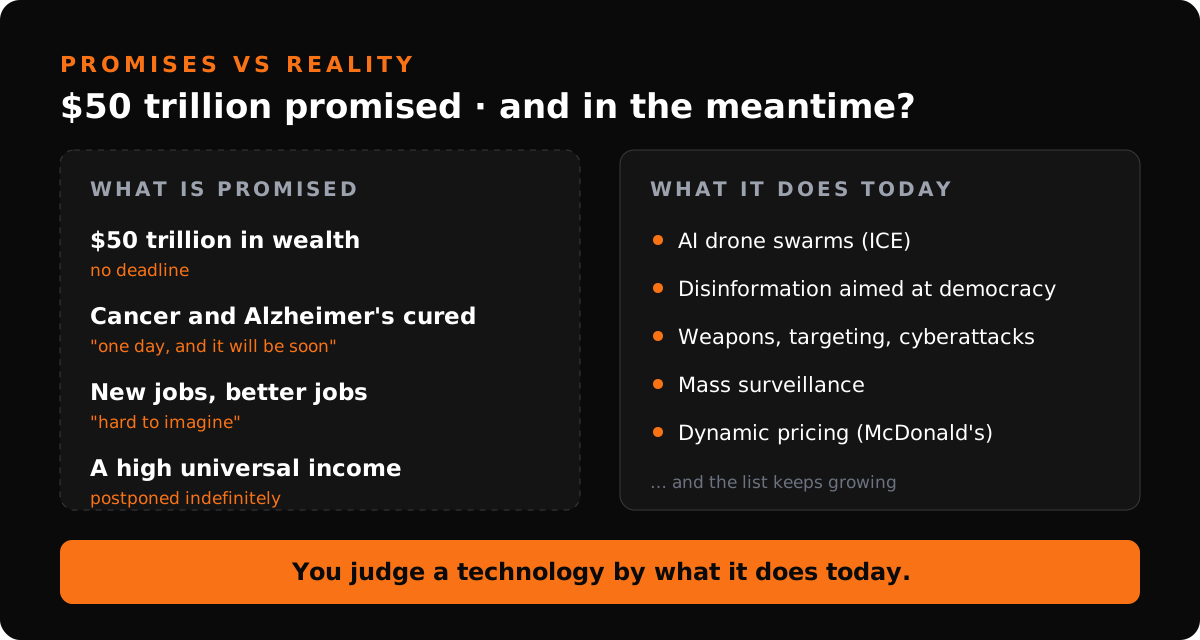
The picture is deliberately dark, and it does not tell the whole story of AI's useful uses. Still, it restates a simple rule: you judge a technology by what it does today, not by what you hope it will do tomorrow.
The jobs question: the dodge
Then there is the question everyone asks: will we still have jobs? I want a simple, direct answer: jobs, will we still have them? The first answer, from an industry executive, is the classic one:
"I think there will actually be strong demand for jobs, but not necessarily the same ones. Some jobs will disappear. There will be new jobs, better ones."
Great, I'm sure we all love the new, better jobs. So what exactly are they?
Here is what I get told:
"They are hard to imagine, while we dream about what the future will look like."
That's a bit thin coming from people who picture humans living disease-free on Mars without breaking a strain. So I'll say it plainly: you high-IQ assholes imagined a disease-free life on Mars, but jobs are beyond the limits of the cosmos?
Jensen Huang, Nvidia's boss, tries in turn:
"I believe we will see jobs change at mass scale. I believe there will be net job creation."
Ah, net creation. And these jobs would be which ones?
To illustrate, he cites industries that did not exist midway through his life:
"There are a whole bunch of industries that exist today and did not exist, say, halfway through my life. Wellness centers and spas, for example."
The example is weak: spas have existed since antiquity. Here is an industry with nothing new about it, cited to prove the economy knows how to renew itself.
You went looking for an industry that didn't exist a few years ago, and you found spas? We have ruins dating back to 2000 BC! Are you kidding me?
The heart of the problem is not the clumsiness of an example. It is that the people building these systems do not know, or do not want to name, the jobs of tomorrow. If machines do most of the work, the logical conclusion is that employment becomes a leisure activity, which nobody presents as a societal project.
So stop kidding us and admit it: if it works the way you say, there won't be many jobs left. If you want a job, you can have one as a hobby.
The high universal income: why wait?
Asked about the future of office work, another industry executive replies with an abundance scenario:
"I think, from afar, the most likely outcome is an age of abundance, where we will have not just a universal basic income, but a high universal income."
In plain terms, enough unfettered capitalism and we end up with something close to socialism.
If we let them practice enough unfettered capitalism, we can apparently capitalise our way to socialism. Sounds great.
The argument turns around easily. Suppose AI creates $50 trillion in wealth and the State can then redistribute: why not start right now? If abundance is certain, nothing stops us from paying out its first fruits now. The fact that it keeps getting postponed says a lot about how certain those promises really are.
If the ultimate goal is to create a huge flood of money and then hand it to people for free, quick question: why wait? If $50 trillion leads to a future where the State has enough money to give to the population, why not give us the $50 trillion right now?
And above all, don't call us dependents: just call us pioneers.
A sector that self-regulates
Another point that stands out: these are the same executives who are supposed to frame their own technology. Their position, as it comes out of the debate, is that the new world they are building must advance without regulation and without financial limits. The reason given: it is important work, done by important people.
So to you, high-IQ individuals charged with regulating yourselves across the minefield of this new technology, I ask only one thing: a direct answer to a simple question.
They add that this technology is the natural result of a system that rewards progress and innovation. The argument holds up, but it forgets the essentials: handing regulation to those who profit from it creates a clear conflict of interest. And when those same people cannot say which jobs will remain, you understand why the public demands guardrails.
And you will never believe where that leads. I'll bet they will still have a job when it's all over.
FAQ: AI promises and real-world applications
What are the current real uses of AI today?
Currently, AI is used for various purposes that critics highlight negatively, such as AI-driven drone swarms for tracking immigrants, spreading disinformation, designing weapons, mass surveillance, and dynamic pricing tools.
Will AI lead to job losses?
AI's impact on jobs is uncertain. While some jobs may disappear, there is also a belief that new and better jobs will be created, though specifics on these jobs are often vague and hard to imagine.
What do AI promoters promise for the future?
Promoters of AI promise transformative benefits, including access to world-class healthcare and education, and solutions to major diseases. However, these promises often lack specific timelines, making them feel more like vague hopes than concrete commitments.
What to keep from this
This take is deliberately sharp, and it does not tell the whole story of AI's useful uses. But it raises three legitimate questions any business owner can put to a vendor or an overly enthusiastic pitch:
- What is the counterparty, and by what date? A promise without a deadline is not a commitment.
- What does the tool do today? It is the real uses that count, not the vision.
- Who is affected, concretely? If nobody can name the jobs of tomorrow, better to prepare your teams now than to wait for an answer.
The right posture is neither technophobia nor naivety. AI already delivers real gains in business: time saved, quality, automation of repetitive tasks. It also justifies frank questions about its risks and about how the value it creates is shared. Those who avoid those questions may not be acting in bad faith, but they have not earned being taken at their word.