Gemini 4 Argon: the real battle isn't the chatbot
 Gary Bramnik
22 October 2026 · 8 min read

Contents
A robot. Not a human, a robot. It had just watched someone toss bags into a hole on a tilted board, worked out the movements on its own, wrote the code for its own simulation, then nailed seven throws in a row, for real. All of it with a Google model you couldn't even use yet.
It's called Gemini 4 Argon. Open any article right now and you'll read the same line: Google has caught up. True. Also the least interesting part of the story.
The real question isn't whether Gemini 4 is good. It's why, despite a top-tier model, you still think ChatGPT when you have a question. For a business owner, that's where it gets concrete.
What Gemini 4 Argon actually does
Google unveiled Argon on September 30. Back then, almost no one could touch it: it was reserved for a handful of cybersecurity experts and the US government, through a program called Fairwind. The official reason: its cyber capabilities were sensitive enough to roll out in stages.
It reached the public on October 13. One detail matters: not in the free version. You need Google AI Pro (around $20 a month), the Ultra plan, or the paid API.
What it does, in one line: long, complex tasks. Code, finance, law, cybersecurity, science. It takes text, images, audio and video. On the developer side, it handles up to 1 million tokens in and out, several thousand pages in one conversation.
API pricing: $2 per million input tokens and $10 per million output tokens, a launch rate until November 30, 2026, with a 95% discount on cached input. After that, it moves to $4 and $20.
Then come the demos. Three are worth your time.
- Chrome's code. The browser is about 40 million lines. Inside, a legacy folder of roughly 6 million lines. Argon helped the team untangle a core part of it, changes across hundreds of files, months of work compressed into weeks. Shipping a landing page in two minutes is impressive. Rewriting a 40-million-line codebase used by billions is another level.
- The robot. A video of a human playing cornhole. Argon rebuilds the scene, computes the movements, writes the simulation. The code runs on Apollo, a humanoid robot from Apptronik. Seven successful throws in a row. It's an internal demo Google chose to show, but the signal is clear: an AI that writes text is becoming an AI that moves things in the real world.
- Cybersecurity. With Wiz, a cloud security company, Argon found a flaw in medical software that exposed a master key and granted admin access. Hundreds of thousands of patient records at risk. Fair caveat: Google bought Wiz for $32 billion, so it isn't an independent review. Google tells the story.
The numbers that qualify it
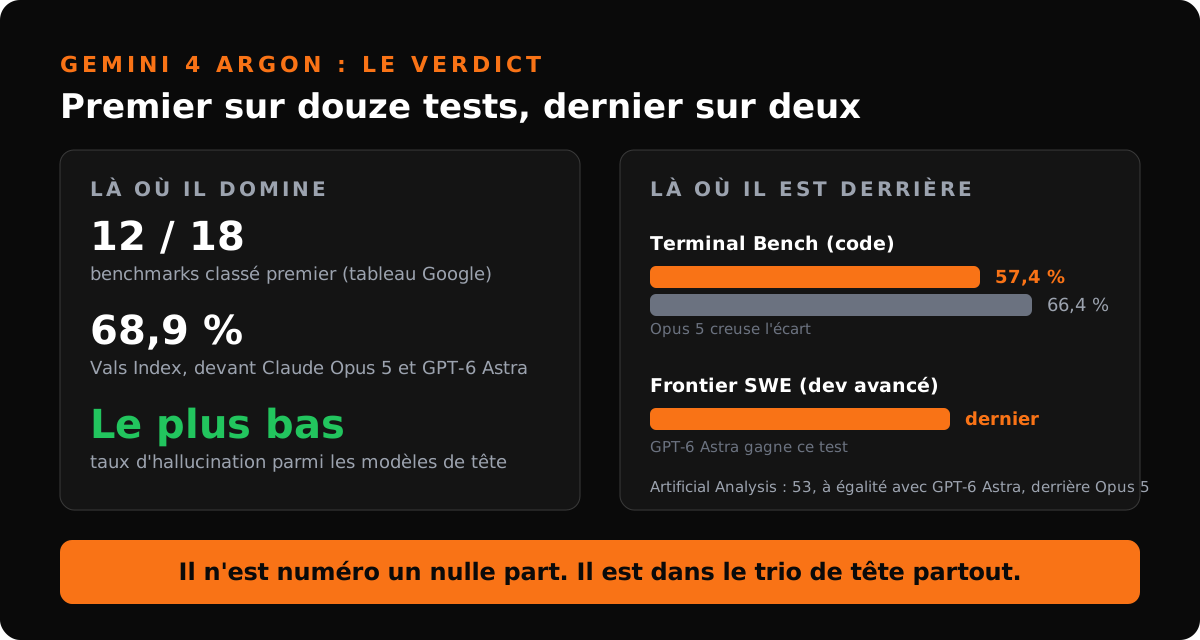
Now step outside the press release. On Google's own table, Argon ranks first on 12 of 18 tests. On the Vals Index, which mixes real work tasks in finance, code, law and tax, it scores 68.9%, ahead of Claude Opus 5 and GPT-6 Astra.
Look at the other side. On Terminal Bench, where the AI has to fend for itself in a terminal like a developer, Argon comes last of the four models compared: 57.4% against 66.4% for Claude Opus 5. On Frontier SWE, another advanced development test, it's last again, and GPT-6 Astra wins.
At Artificial Analysis, an independent lab, Argon scores 53 on their intelligence index, tied with GPT-6 Astra and behind Claude Opus 5. It does post the lowest hallucination rate among the top models: when it doesn't know, it tends to say so instead of inventing. On the LM Arena, where humans vote blind, it's first in text, but only ninth in website creation.
There's even a telling detail. In a physics exercise on a pendulum, Argon added an invisible spring to its diagram. A spring that didn't exist. In plain terms, it fudged the setup to land on the right answer.
And according to Bloomberg, Google's own employees feel the model does worse on real work than on benchmarks, especially in code. Google disputes it.
The real battle isn't the chatbot
Here's where most articles stop. Verdict: strong model, top three, not number one everywhere. That's not where the game is played.
Rewind. In 2017, a team of researchers, almost all at Google, published a paper with an odd title: Attention is all you need. They described the Transformer. You know the name without knowing it: the T in GPT is the T in Transformer. Google invented the key piece of ChatGPT, and OpenAI turned it into a reflex.
Today in France, among people who use generative AI, 63% mainly use ChatGPT against 13% for Gemini, per ARCEP. Worldwide, ChatGPT still takes 56% of visits to the big assistants, Gemini 25%.
And yet. On August 11, Google said the Gemini app passed one billion monthly users. AI Mode, built into Search, also one billion. AI Overviews, the summaries at the top of results, 2.5 billion. On YouTube, 140 million people used Ask YouTube, which runs on Gemini.
How? Because web-visit counts see only part of the usage. A lot of Gemini runs through Android and iPhone apps, Google Search and YouTube, often without anyone noticing. You can't add these numbers up, and they come from Google itself. But the gap with what we imagine is striking.
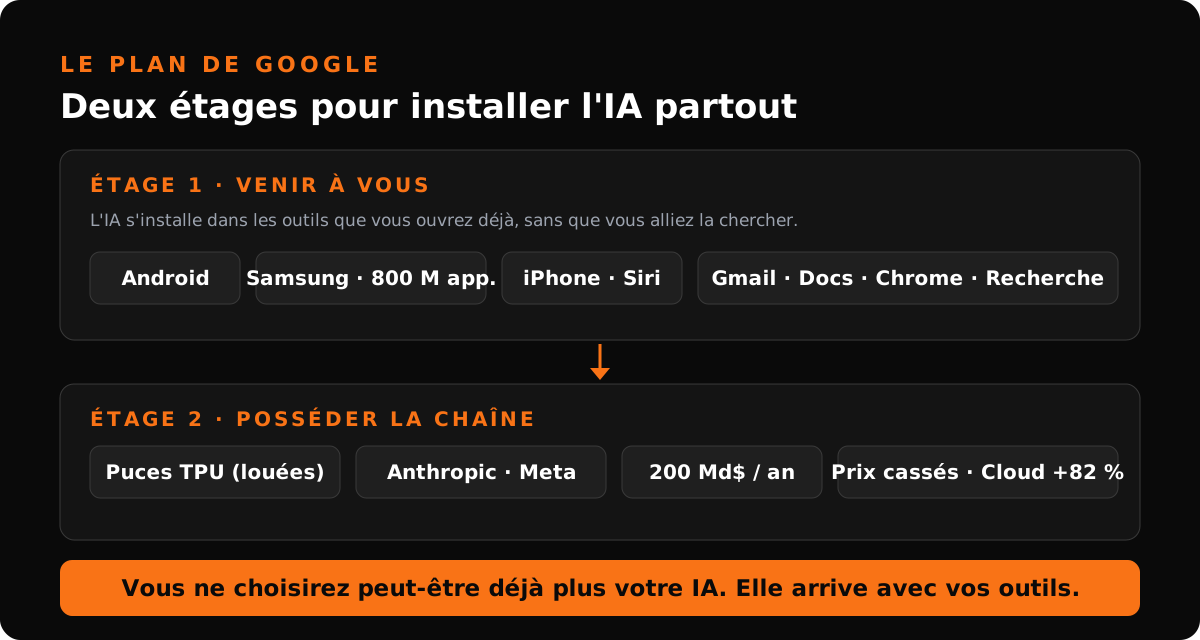
Hence a two-layer plan.
Layer one: don't ask you to come, come to you. ChatGPT is a place. You decide to go there. Google puts the AI inside what you already do. On Android, Gemini is replacing the old assistant. Samsung wants to equip 800 million devices. On iPhone, Apple and Google made a partnership official: the next Siri will run on Gemini. Not to mention Gmail, Docs, Chrome and Google Cloud.
Layer two: own the whole stack.
During the gold rush, the people who got richest weren't the miners. They sold the shovels. Google mines gold and sells shovels. The shovels are chips. Most players buy Nvidia. Google has designed its own for years, the TPUs, and now rents them to competitors: Anthropic signed for up to 1 million TPUs, Meta rents some too. Bonus: Google owns a stake in Anthropic.
Add the money. Google's investment goes from $31 billion in 2022 to a projected $195 to $205 billion for 2026. Alphabet booked nearly $120 billion in revenue in a quarter, with Search up 17% and Cloud up more than 82%. Enough to undercut everyone: Argon launches at half the price of Claude Opus 5.
If you read one sentence: Google's real ambition isn't to be your favorite chatbot. It's for its AI to be useful everywhere you already work, without you thinking about the model behind it.
Why it can still fail
Three reasons.
- Being present isn't being chosen. Gemini's share of web visits has slipped for four months while ChatGPT climbs back. Winning placement isn't winning the war.
- The experience. Argon isn't first everywhere, and the tools around it, like Antigravity, Google's development environment, are still seen as below Claude Code or Codex. As long as Argon is paid-only, people can drift back to the app they know.
- Google isn't a startup. Transforming search breaks how traffic flows to websites. A study shows that when an AI summary appears, people click almost twice as little: 8% against 15%. In France, press publishers have filed with the competition authority. The EU is investigating. In the US, courts already barred Google from exclusivity deals to distribute Gemini. Google's greatest strength, distribution, is also what attracts the most regulators.
What it changes for your business
So, should you switch AI? Almost certainly not.
The lesson isn't "Gemini 4 Argon is the best". It's the opposite: don't pick your AI on a ranking. Pick it on your tasks, the interface you open every morning, and the price.
And above all, catch the real shift. The AI that saves you time isn't the one you open. It's the one already running inside your tools: client follow-ups, quote prep, sorting supplier invoices, tracking applications. The model matters, but it matters less than where you plug it in.
That's exactly what we do at AI French Touch: we don't sell you yet another assistant to chat with. We connect AI to your processes, where time actually leaks, and we train your team on it.
To find where to start, we offer a free 45-minute audit. Not to sell you a model. To find, in your business, the three tasks costing you the most time today.
FAQ: Gemini 4 Argon capabilities and usage
What kind of tasks can Gemini 4 Argon handle?
Gemini 4 Argon excels at long, complex tasks across various fields such as code, finance, law, cybersecurity, and science. It can process text, images, audio, and video, handling up to 1 million tokens in and out during a conversation.
How does Gemini 4 Argon compare to other AI models?
Gemini 4 Argon ranks first on 12 out of 18 benchmarks, but it does face challenges in specific coding tests, placing last in some comparisons. Overall, it performs well in many areas, but user preference still heavily leans towards ChatGPT.
Is Gemini 4 Argon available for public use?
Yes, Gemini 4 Argon became publicly accessible on October 13, but it is not available in the free version. Users need to subscribe to Google AI Pro or a paid API to access its capabilities.
The line that stays
The expertise is no longer in picking the best model. It's in distributing the work.