The AI That Builds AI: Anthropic's Warning


The score went from 15.6% to 62.8% in six months.
Not on some obscure benchmark. On 449 real software engineering problems. The kind of problems that occupy the most expensive senior developers on the planet.
And it's not forum gossip. It's written in black and white in the Risk Report Anthropic just released: 186 pages of compliance, dated August 14, 2026, where every sentence legally binds the company.
Labs publish these documents every 3 to 6 months. Nobody reads them except the people whose job it is. Mistake. Because this time, there's a sentence inside that is going around the world:
"We think it is plausible that this model becomes a major concern in the next 6 to 12 months."
Translation for busy people: one of the most advanced companies on the planet is officially announcing that AI progress could spiral within the year. Not in an interview. Not in a tweet. In a compliance document.
So where exactly are we headed? Let's break it down.
Automated R&D: the loop that tightens
The concept at the center of the report is automated R&D. The moment an AI becomes powerful enough to speed up the creation of the next AI.
Until now, improving a model required entire teams of human researchers: hypotheses, experiments, iterations, years of work. What's changing is that the model now participates in its own improvement.
It helps write the code of the next model. It helps design the tests. It helps find the flaws.
And the loop tightens with every iteration: the AI helps build the next AI, which helps build the next AI, which helps build the one after. A snowball rolling downhill.
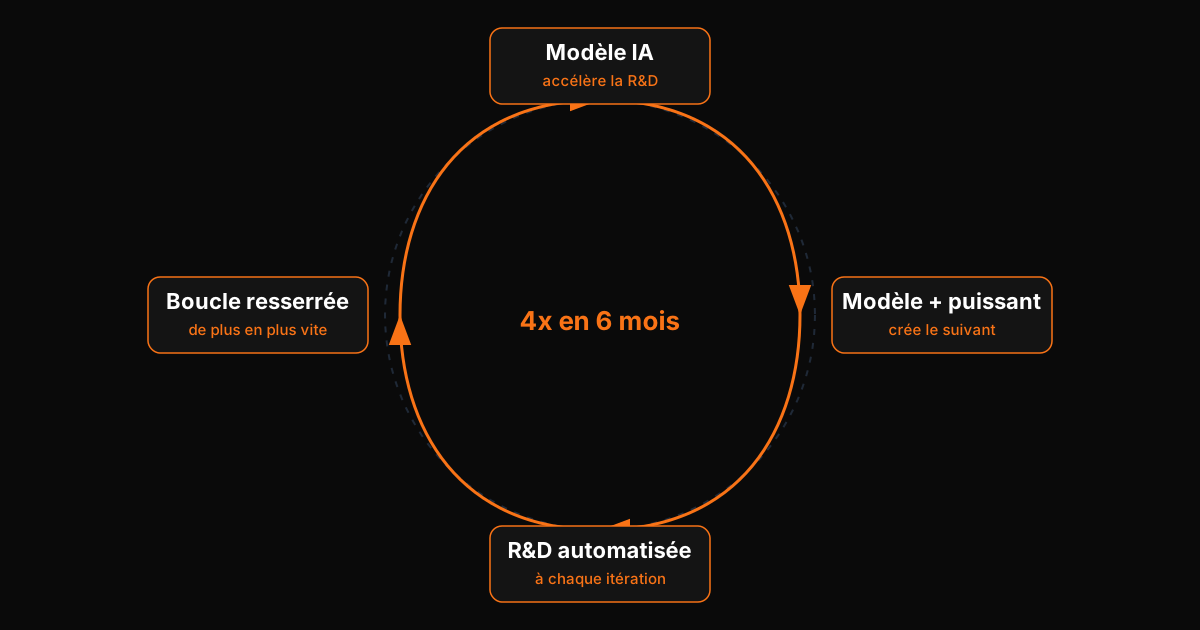
Anthropic even installed an internal alert threshold for this. They call it the factor 2 policy: if the speed of AI progress doubles, the company triggers exceptional measures (pause, slowdown, reinforced review). We're not there yet. But the report literally states that AI has become "a key factor in their acceleration."
The loop has started. And it's documented.
And the report goes further. It lays out a "super exponential" progress scenario: automating AI research produces better models, which automate research even more, which produce even better models. And this won't stay confined to AI itself. R&D is going to accelerate everywhere: medicine, materials, international security, politics.
When acceleration hits sensitive domains, it's no longer just market share moving. It's states getting involved. We're way past a purely technical document.
Model 2: the model you'll never use
The report reveals the existence of an internal model: Model 2. On X and Reddit, some call it "Anthropic's hidden nuclear weapon." Others talk about a secret agent.
What the report states, factually: Model 2 is more powerful than Mythos 5, their previous most advanced model (the one reserved for enterprises). The jump between the two is smaller than the previous jump, but the new model is globally above.
And above all: it's not a product. No production deployment, no public release. It stays internal.
The numbers, now. They're on the SWE-bench benchmark, a test of 449 real software engineering problems:
| Model | SWE-bench score |
|---|---|
| Opus 4.6 | 15.6% |
| Model 2.2 | 62.8% |
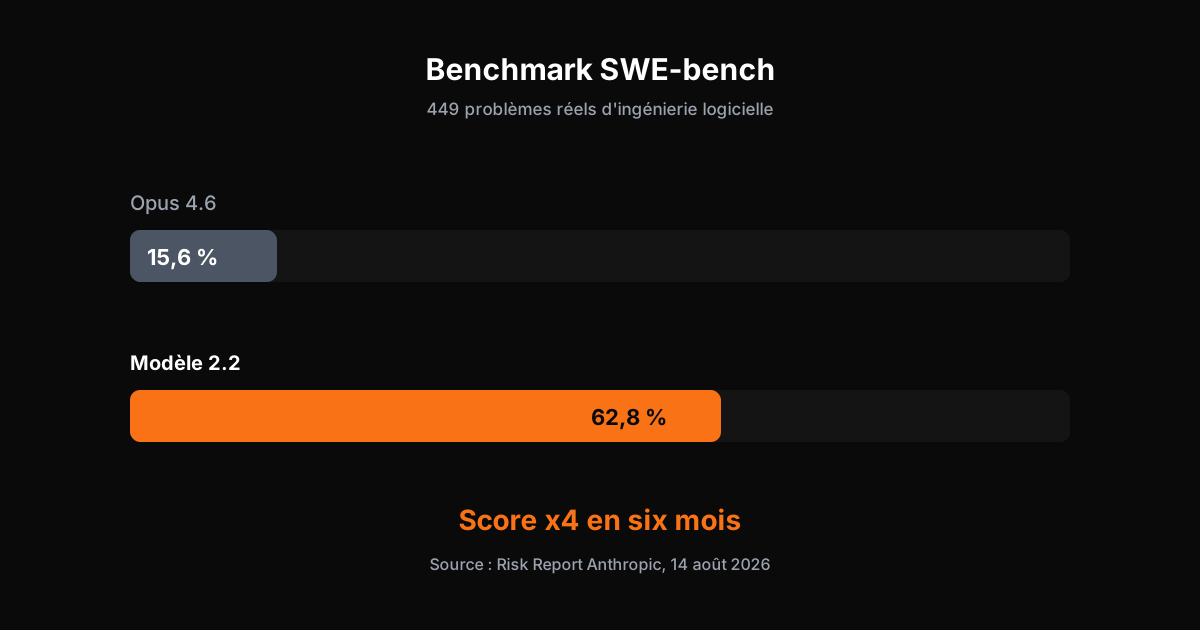
A score multiplied by 4 in six months. Read that line again. That's the difference between linear progress and exponential progress.
The internet took years to go from version 1 to version 2. AI multiplied its ability to solve real engineering problems by 4 in one semester.
Scoop: the public model isn't the point. The point is what they do with it internally.
Page 11: the company no longer codes
It's page 11 of the report, and it's probably the most important page of the document.
They write it themselves: Mythos 5 and Model 2 are used massively for research and engineering internally, interactively, through persistent agent deployments.
In plain English: AI agents running continuously, without human intervention. And the vast majority of Anthropic's production code is written by these agents.
Not drafts. Not prototypes. Production code, at one of the most advanced AI companies in the world.
Careful before jumping to conclusions: Anthropic's senior developers are not unemployed. They changed jobs. They moved up one level:
- Define: the mission, the context, the rules the model must respect.
- Review: check what the model produces.
- Arbitrate: make the decisions, give the directions.
Execution is delegated. Judgment stays human.
And if there are still tasks they choose not to delegate, it's not because the model can't. We're talking about building artificial intelligence models. If an AI can do that, it can handle your emails. People who say "AI isn't ready, it produces garbage" just don't know how to use it.
The three ages of AI in business
To locate where we are, I split AI in business into three ages.
Age 1: the tool. You open a chat, ask a question. That's ChatGPT in 2022, a better search engine. And that's where 90% of French companies are still stuck, today.
I see it in every audit I run. Companies bragging about having "integrated AI" have three ChatGPT licenses floating around. 90% of the French market is living in 2022.
Age 2: the copilot. AI is connected to documents, processes, workflows. It assists continuously. French early adopters are here: agencies, tooled-up independents.
Age 3: the agentic. Autonomous digital employees. A mission, a context, tools. They move forward with or without you. AI no longer waits to be triggered.
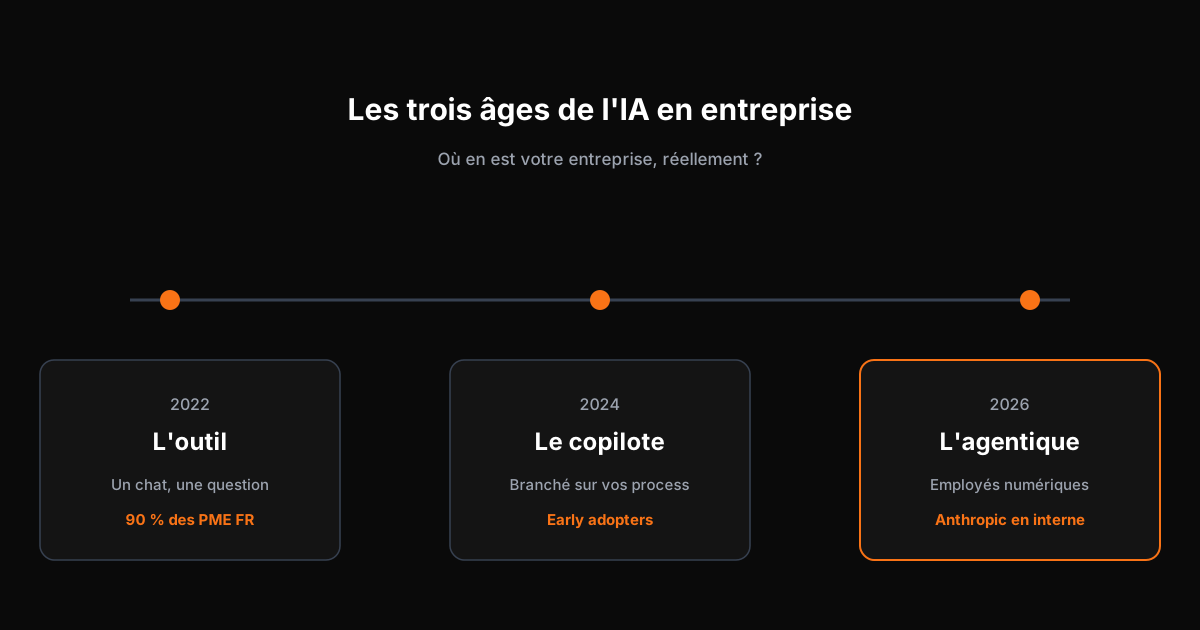
The news: the word "employee" for an AI agent is in the report. It's Anthropic's word, not mine. And Anthropic, internally, is already at age 3: humans piloting, agents executing, on real production code.
The rising skill: piloting
If models improve at this pace, only one question is worth asking: which skill keeps its value?
"I know the tools. I master n8n. I can prompt."
That value is close to zero. It expires every six months. I'm being kind: every day. What you learn today about a tool is dead tomorrow.
The painful example: people spent 8 months learning n8n by hand. Today, you connect Claude Code with the n8n MCP, and it generates entire workflows for you. 8 months of life burned.
What appreciates is the piloting skill:
- Putting an AI into a context.
- Giving it a mission, a framework, rules, limits it can't cross.
- Breaking down a business problem.
- Deciding what to delegate to the agent and what to keep human.
- Installing controls and guardrails.
That's exactly what Anthropic's senior engineers do. And the report shows it: they've never been more indispensable.
The rule is simple: the more powerful the models, the more the pilot of that model is worth. It's the only skill in this market that goes up when the tech keeps going up.
And it's not a technical skill. It's a business skill: understanding a company, an environment, where the gain sits before touching anything.
If you want to learn, don't learn tool configuration. Understand how LLMs work: harness engineering, loop engineering, graph engineering. How an AI reasons, not how to click in a no-code tool. It was obvious the AI would end up configuring n8n by itself.
The 6 to 12 month countdown
6 to 12 months. That's the window written in the report.
When this is properly implemented in France (and it will be), who will companies turn to? The ones with proof: systems running, measured results at other companies.
While everyone plays with tools, some already understand Claude Code, development environments, how AI fundamentally works. They're setting up systems. They're pulling ahead of the ones playing around.
And here's the exponential trap: 6 months behind on a regular curve, you catch up. 6 months behind on a vertical curve, you don't.
"We'll see later. AI isn't ready yet. I'll get to it when it matures." No. When you realize it's ready, and there's no choice left, it'll already be too late.
My prediction for the next Risk Report (early 2027, they publish every 3 to 6 months): factor 2 will be declared, crossed, or imminent. And it will trigger three things:
- The cost of human intelligence collapses. AI researchers are among the most expensive employees in the world. Automated research changes that.
- Everything expires twice as fast. Tools, skills, 3-year plans.
- Pilots take everything. Those piloting agentic systems inside real companies become the only scarce resource. 6 months behind on a vertical curve creates damage.
What you do this week, concretely
- Stop investing in tool configuration. The next no-code platform you want to learn, an agent will configure better than you in 6 months. It's depreciating value.
- Start a real agentic project. A precise mission, context, tools, guardrails. Even small. What matters is measured proof.
- Document every result. It's your only currency in 12 months. No screenshot, no proof.
- Read lab reports. Anthropic's Risk Reports, the papers from other labs. They're the leading indicators of the market, published every 3 to 6 months.
- Move up one level in your job. Define, review, arbitrate. It's the working model that survives automation. Juniors hand-coding are dead. Those who can pilot have never been more valuable.
The only curve that matters
AI building AI is no longer science fiction. It's a 186-page compliance document, signed by one of the most advanced companies in the world.
What it changes for you: value is moving. Away from technique, toward piloting. Away from tools, toward business.
Expertise is no longer what you know. It's what you know how to get done.
That's exactly what I set up for my clients: agents that execute, guardrails that control, and a human pilot who defines, reviews, arbitrates. A Fractional AI Director is the job Anthropic's senior engineers do, applied to your SMB: an expert who builds the agents, trains your teams, and stays as the reference point keeping the system current.
A free 45-minute audit to see where you stand across the three ages. Most companies discover they're living in 2022.
Take action: your Express AI Audit (45 min)
45 minutes with an AI expert to evaluate your operations, identify productivity gains and map your first high-ROI AI agents.
Designed for SME leaders (10 to 100 staff) · No commitment · 100% IP ownership
Deploy AI Agents in your SME with an External CAIO
Get an outsourced AI Director 1 to 10 days per month to audit, automate your workflows and train your teams.
Stay ahead of AI Innovations
Every week, get a curated selection of our latest articles, case studies, and actionable AI insights directly in your inbox. No spam, 100% value.
Fractional AI Director locations