Multi-model orchestration: cut your AI costs by 80% without losing quality

I almost wasted $45 to ask if this was Greek yogurt
Here's what happened to me this week. I'm traveling in Hungary, standing in a supermarket, staring at a pot. I grab my phone and type: "Is this Greek yogurt?", giving it the full context, the brand, the ingredient list, my entire conversation history...
Fable 5. The most powerful model out there.
Result: I probably spent more in Fable 5 tokens asking that question than the yogurt itself costs. That's the reality of AI in 2026.

And that's exactly the problem. Most teams use a single model for everything, writing, debugging, design, strategic analysis, repetitive tasks. It's like using a fighter jet to go buy bread. The result: bills that explode for tasks that models costing 10x less would handle just as well.
I decided to test this. Four real-world challenges, the most powerful models on the market, results that change how you should think about AI in business.
The real numbers (not the benchmarks)
Scoop: benchmarks are as reliable as Rotten Tomatoes reviews. They give you a trend, but they predict nothing about what actually happens in the real world.
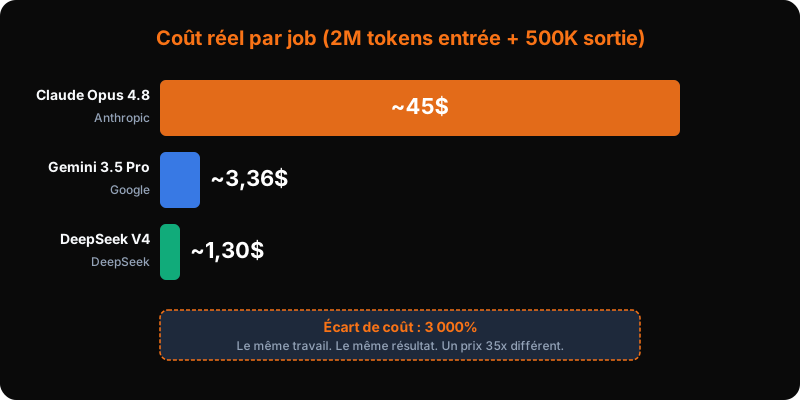
So I looked at actual cost instead. Same job, 2 million input tokens, 500,000 output tokens. Here's what it really costs:
| Model | Cost per job | My take |
|---|---|---|
| Claude Opus 4.8 (Anthropic) | ~$45 | The Lamborghini, 0 to 60 in record time, but it'll cost you |
| Gemini 3.5 Pro (Google) | ~$3.36 | Solid mid-tier, great for review and mobile |
| DeepSeek V4 | ~$1.30 | The sleeper, incredibly good at editing if you give it a framework |
The difference isn't 10%. It's 3,000%. Yet most teams pay Opus 4.8 prices for tasks Haiku 3.5 or DeepSeek V4 would handle equally well.
The core concept you need to get, otherwise none of what follows makes sense: it isn't the model, it's how you use it. Using Fable 5 without knowing the right strategies is like giving someone a level 99 account and dropping them in a game with zero experience. The player is as important, if not more important, than the model itself. An expert with a weaker model will always beat a noob with the best tools.
The 4 tests: what actually changes?
Test 1: the cold email, Opus 4.8 vs Fable 5
Same prompt. Same task: Firecrawl scrape of a website, write a 150-word cold email to book a 15-minute discovery call.
Result? Virtually indistinguishable. Subject lines differed slightly, logic was marginally better on one side, but no human would notice the difference.
Fable 5 is a little better at quoting text, but for pure copywriting... it's tight. Really tight.
Takeaway: for transactional writing, emails, follow-up scripts, standardized messages, the premium model adds nothing. Save your budget for where it matters.
Test 2: website design, Opus 4.8 solo vs Opus 4.8 + secondary models
Opus 4.8 alone produced a decent site. But with the characteristic "Claude look", you know the one, everything looks the same, that "Claude design poison" you can spot from a mile away.
So we brought in reinforcements: Gemini for mobile review and DeepSeek for copywriting. And the quality jumped. Gemini caught mobile layout errors Opus had completely missed. DeepSeek challenged the copy and improved it.
That's how it works. Initial design = Fable 5 or Opus 4.8. Then you bring in a team of secondary models to cross-check, fix, improve. It's the creatine of the AI world, an insanely powerful hack.
Test 3: the dashboard, Fable 5 vs Opus 4.8 vs Sonnet 5+ Swarm
The most revealing test.
Fable 5: best result, no surprise. More original design, less "Claude design poison." It's its most powerful agent, it understands what good design looks like.
Opus 4.8: decent but more standardized. The kind of thing where you go "yeah it's fine" without ever going "wow."
Sonnet 5+ swarm, multiple cheap models working together: failed. Completely failed. The only one of the three with the guts to try something different, but... it was bad.
Takeaway: an intelligent orchestrator is ESSENTIAL. Multiple weak models without a coordinating brain = chaos. This is proof that the orchestrator's quality determines the output quality, not how many models you stack.

The golden rule: right model, right task
When to pay for premium (Fable 5 / Opus 4.8)
You want to tag in Fable 5 under these conditions. And by "taste," I mean that thing that makes the difference between decent and excellent:
- Design and visual architecture, Fable 5 is "a cut above." It's its most powerful agent. For all initial design work, that's the one.
- Strategic decisions, "one-way doors", you know the Jeff Bezos analogy: most decisions are reversible, some are one-way doors. That's Fable 5 territory. The cost of getting it wrong is too high.
- Critical debugging, when nothing else works, the premium model is the one that finds hidden errors.
- Orchestration, coordinating multiple models demands superior intelligence. It's the only role that truly justifies the price.
When to use budget models
- Editing and correction, DeepSeek V4 with an editing framework is "incredibly great" when the structure already exists. This is a real blind spot for people who don't test cheaper models. Not many people know this.
- Transactional writing, emails, follow-up scripts, standardized messages.
- Volume tasks, data processing, cleaning, classification.
- Verification sub-agents, checking other agents' work doesn't need the Swiss army knife.
The 5% rule
In practice, only 5% of your decisions require the premium model. That's it. If budget allows, you can go up to 50/50. But 95% of routine tasks run perfectly on Opus 4.8 or DeepSeek V4.
Think about it: you're already paying for Opus 4.8 in your subscription. Fable 5 is pay-per-token. So you only bring it in for high-value work where taste makes the difference and the ROI is clear.
The 6 concrete hacks to cut your costs
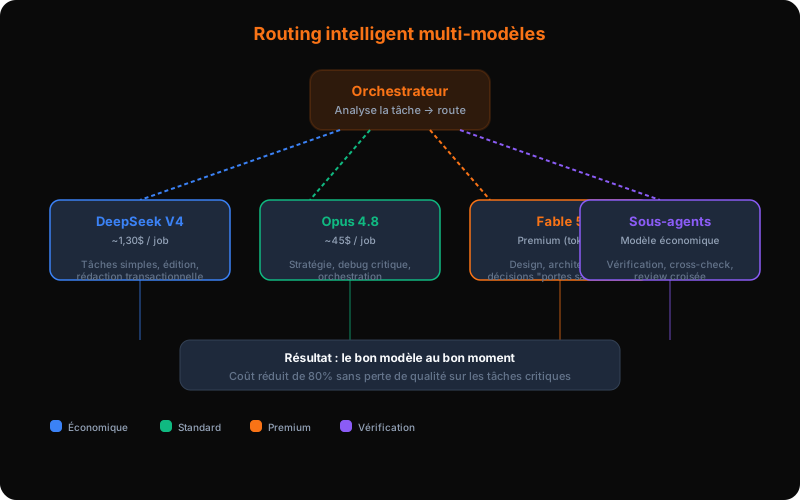
1. Smart routing
Never ask the premium model to do what a budget model handles well. We tag in Fable for the math, but we don't ask it to mop the floors.
- Simple task → DeepSeek V4 or Haiku 3.5
- Task requiring "taste" or strategy → Opus 4.8
- Initial design → Fable 5, then edit on secondary models
- Verification → sub-agents with budget model
2. Clean your context windows
Stealth files in history, CLAUDE.md, skills, MCPs, rebuild with every message. 20,000 invisible tokens per conversation. It's like paying a surcharge every time you open your mouth. When a task is done, open a new window. Period.
3. The first prompt matters most
This is something we never say enough. The moment you give your first instruction to the model, that's where 80% of quality and cost is determined. If you miss it and loop corrections, not only does quality degrade, but costs explode. Take the time to specify correctly from the start. Pro tip: draft the prompt with a cheaper model, then fire it like an arrow, Alex Pereira style, straight at the bullseye on the premium model.
4. Trim unnecessary context
Remove bulky context files when they're not needed. Use Firecrawl to get plain text only, not HTML, no useless code eating your tokens. Keep system prompts compact. Scoop: Anthropic already does an excellent job with default prompting. We steer, we direct, but we don't let the system prompt run wild.
5. Adapt your thinking level
For general questions, "low" thinking level on a premium model often outperforms "very high" on a mid-tier model. And it costs far less. It's counterintuitive, but it's the truth.
6. Never ship without cross-review
This is the most important piece of advice in this article. Never deploy without another model validating. Your models will tell you everything is perfect, until you tag in Codex or Gemini and lo and behold, they find critical errors. It's happened to me so many times it's become a non-negotiable process. Your models will lie to you about the quality of their own work. It's human.
Mixture of Agents vs Ministry of Agents
Two different concepts, often confused. And you need to understand the difference to get the most out of your agents.
Mixture of Agents: an orchestrator sends the same question to 3-4 different models. Each responds independently, without knowing who said what. The orchestrator compares notes, synthesizes, takes the best of each world. This technique maximizes quality.
Ministry of Agents: an orchestrator coordinates specialized models on different tasks. Each agent has a specific role, drafter, editor, reviewer. This technique maximizes efficiency.
In both cases, it's the orchestrator's quality that determines the output quality. A weak orchestrator with 4 powerful models produces chaos. We saw it with the Sonnet 5+ swarm.
The costly mistakes
- Using the same model for everything, the default waste pattern of 90% of teams.
- Ignoring DeepSeek V4, test it for editing with a dedicated framework, you'll be surprised. It's an open secret.
- Skipping cross-model review, your models will lie to you about the quality of their own work. It's happened so many times...
- Neglecting the first prompt, that's where 80% of quality and cost is determined. Take the time.
- Keeping the same conversation windows, every message rebuilds the full context, stealth files come back, tokens accumulate. Open a new window when you're done.
In practice
For a company intensively using AI, smart multi-model routing can divide the bill by 4 or 5 without sacrificing quality on critical tasks. Expertise is no longer in choosing the best model, it's in the optimal distribution of work.
Slash your AI bill by 4 with an Externalized AI Direction
AI cost optimization and smart model routing are essential to make large-scale AI deployment profitable.
With our Externalized AI Direction, we establish this governance:
- Automatic query routing between frontier models (critical tasks) and budget models (volume).
- Context window optimization and strict API token management.
- Monthly cost savings reports and continuous routing rule adjustments.
Ready to structure your AI strategy?
Access a dedicated senior AI Director to automate your workflows and train your team.
Discover Direction IA Externalisée