GPT 5.6 Soul vs Fable 5: When AI Picks Its Boss


I spent an entire day pitting two AI models against each other on real tasks. The result surprised me, and it completely changes how I distribute work between my agents.
Soul, OpenAI's new model, costs 3 to 20 times less than Anthropic's Fable 5. On simple tasks, it wins 24 to 3. And yet, when it's time to think, create, or decide, it's still Fable you call back.
The trap? Believing one model is enough for everything.
The hatchet test: an open world bike game
The idea was simple. Same prompt, launched in parallel: "Build a genuinely fun playable open world bike game that runs in the browser." Full creative freedom.
Fable 5 shipped a 3D game with a GTA-like perspective, a seemingly infinite map, collectible coins, aerial tricks. 21 minutes. $14.22. 90,000 output tokens.
Soul produced a playable game too, but in bird's eye view, harder to control, less immersive. 23 minutes. Only $4.50. 31,000 output tokens.
Fable's quality wasn't just a little better. It was on another level. But Soul used 3 times fewer tokens for a result that remains perfectly playable.
If your task is "ship something that works fast", Soul wins. If it's "ship something that hits hard", Fable wins.

The creative test: a scroll-stopping website
Same prompt, once again: "Build the most impressive interactive scroll-stopping website you can imagine."
Both models produced a narrative scroll experience with a 3D interactive background and music. The same concept, independently.
Fable shipped a 10-billion-year sequence, from the Big Bang to today, with supernovas, particle effects, a real narrative arc. 23 minutes. $19.24. 80,000 tokens.
Soul did something similar, a "Vesper Archive" interactive narrative. Less immersive, but functional. 7 minutes. $1.06. 20,000 tokens.
Here's where it gets interesting: Soul was almost 20 times cheaper. If we'd let Soul spend as much as Fable, would the result have been as good? Maybe. But as-is, Fable has the wow factor.
Soul's quality-to-price ratio is mind-blowing. But Fable's quality ceiling is higher.
The pure API test: 27 calls, one clear winner
This is where the numbers get really interesting. Twenty-seven direct API calls, no agent, no reasoning loop, just "here's something, respond."
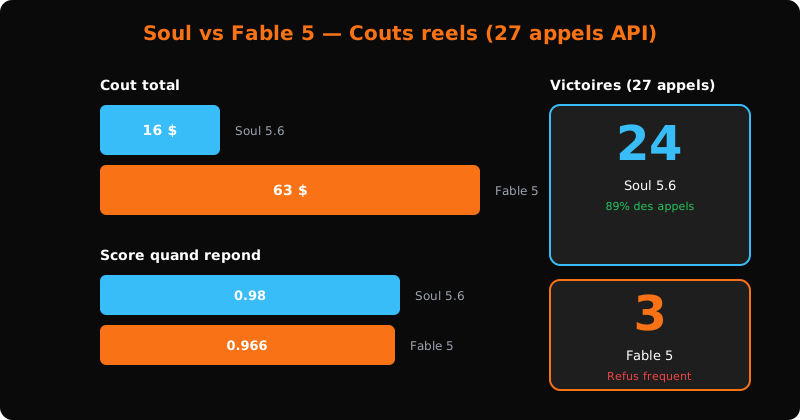
Result: Soul won 24 times. Fable won 3 times.
But here's the catch, Fable refused to answer on quite a few calls. Security guardrails are baked in harder. When Fable did answer, the score was 0.966 vs 0.98 for Soul. Nearly identical.
The real delta is price. Soul: $16 for 27 calls. Fable: $63. Four times more expensive for a nearly identical result when it bothers to answer.
And Soul's token efficiency is absurd. Even at the same price per token, Soul would still be cheaper because it uses fewer. It's probably related to Codex, OpenAI's harness, but it's a structural advantage.
| Criteria | Soul 5.6 | Fable 5 |
|---|---|---|
| Avg cost/call | ~$0.59 | ~$2.33 |
| Avg tokens/call | ~750 | ~2,000+ |
| Score when answering | 0.98 | 0.966 |
| Refusal rate | Rare | Frequent |
The real lesson: unit economics
Here's the concept that will save you thousands of dollars per month.
If your task is worth a 5, you don't need a model that's a 10. You need a model that's a 5 or 6.
That's AI unit economics.
Fable 5 is the Lamborghini. Blazing fast, perfect design, reasoning capacity that defies competition. But you don't take a Lamborghini to buy bread.
Soul is the premium sedan. Less spectacular, but far more efficient day-to-day.
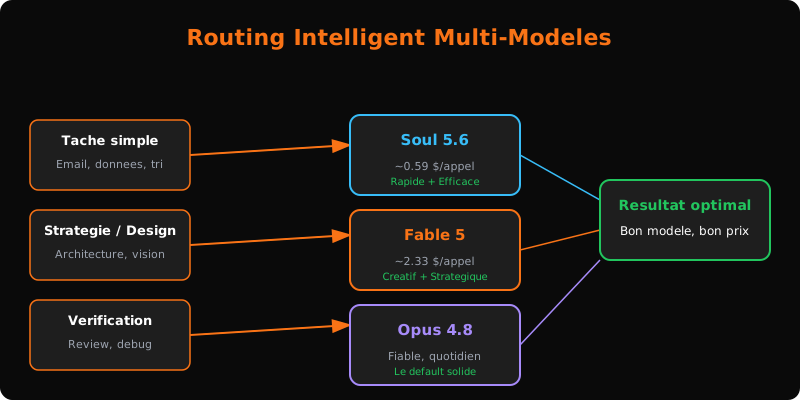
And Opus 4.8? It's the delivery truck. Reliable, solid, not flashy, but it does the job for 90% of tasks.
The real skill in 2026 isn't knowing which model is "best." It's knowing which one to use for each task.
The manager and the executor
After a full day of tests, here's where I land:
Fable 5 is a manager. A co-founder. It doesn't just execute, it pushes back, proposes angles you hadn't considered, it's creative, strategic, better at writing. Sometimes it's even a little sassy, it prefers advising over obeying. Bug or feature, depending on what you need.
Soul is a first-rate executor. Fast, reliable, token-efficient, great at verifying other agents' work. It plays devil's advocate well, it hunts for bugs, checks that instructions are followed. And it doesn't cost an arm.
The winning combo? Fable orchestrates, Soul executes. Fable designs the strategy, Soul deploys it. Fable writes the brief, Soul delivers it.
That's exactly the principle of smart multi-model routing. Not one model for everything, the right model at the right moment.
The final ranking
Here's how I position the four models of the moment:
- Fable 5, The co-founder. Best at creation, strategy, writing, design. Highest ceiling. Highest price.
- Soul 5.6, The perfect executor. Fast, efficient, 3 to 20x cheaper. Best quality-to-price ratio on the market.
- Opus 4.8, The faithful one. Reliable on 90% of tasks. The default model when budget matters.
- GPT 5.5, A notch behind Opus. Correct, but not different enough to justify a switch.
And Soul vs Opus? Very close. Soul is definitely above GPT 5.5 and Opus 4.8. But it's not at Fable's level, and that's why OpenAI priced it where it is.
The mistakes that cost you
Using Fable for everything, The "best model" trap. You pay 5 to 20 times more for tasks a model at half the price would handle just as well.
Ignoring Soul, People stuck on Anthropic are missing a model that costs 3 times less and does comparable work on 80% of cases.
Trusting benchmarks blindly, Benchmarks say Soul "crushes" Fable. Reality is more nuanced. Benchmarks show raw performance, not daily usability.
Not testing on your own tasks, What matters is how the model behaves on YOUR workflow, not on synthetic tests.
Sticking to one model, The default waste pattern of 90% of teams. One model for everything = exploding bills.
The takeaway
Soul isn't the Fable killer the benchmarks suggest. It's a brilliant executor, not a creative rival.
Fable remains the best model available. But it's only the best if you use it in the right places. The rest of the time, Soul does the job for a fraction of the cost.
The question is no longer "which model is best?" It's "which model is best for WHAT I'm doing right now?"
And the answer changes with every task.
Route every task to the best model with an Externalized AI Direction
AI system performance doesn't come from picking a single model, but dynamically assigning the right model to each specific task.
Through our Externalized AI Direction, we design your multi-model architecture:
- Continuous evaluation of newly released market models.
- Deploying routing agents capable of automatic task arbitration.
- Guaranteeing optimal price-performance ratio across all automated processes.
Ready to structure your AI strategy?
Access a dedicated senior AI Director to automate your workflows and train your team.
Discover Direction IA Externalisée