LinkedIn Replaced Its Algorithm: Targeting Beats Reach
Your LinkedIn reach just fell off a cliff? Impressions cut in half over the past few weeks? It's not you. It's not a temporary mood swing either.
LinkedIn replaced its algorithm. Not tweaked, not adjusted. Replaced it, with an AI.
The company documented the change itself in an official 9-page report. And what that report says changes everything for a B2B SMB owner: the reach playbook is dead, and something far more interesting has taken its place.
What the report actually says
The old algorithm was a set of rules written by developers. If a user does X, the system responds Y. Deterministic logic, predictable, and above all easy to game. That's why engagement pods thrived, why virality hacks worked, and why average accounts climbed visibility by playing the system instead of talking to their customers.
That era is over.
The new version is an AI that studies your profile and your activity as a whole. It looks at who you're connected to, what you publish, who you talk to. And it no longer scans keywords: it reads every post in full, understands the topic, and decides on its own who that content is for.
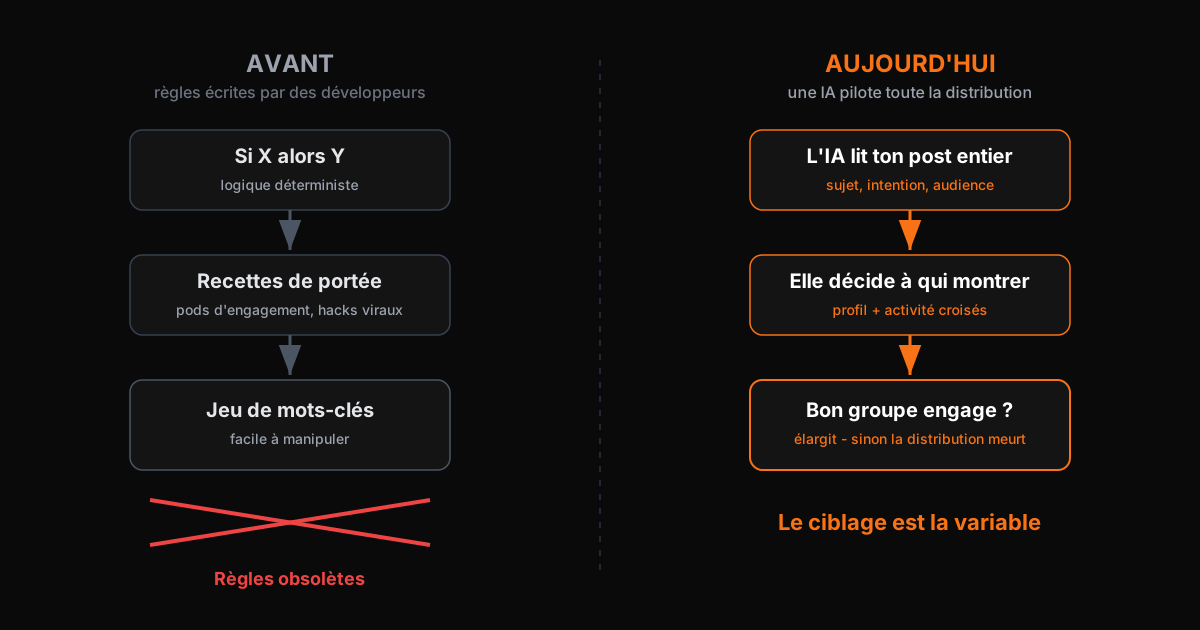
Concretely: when you hit publish, here's what happens.
- The AI reads your post and determines who it's for.
- It distributes the post to that target group.
- If that group engages, it assumes its guess was right and widens distribution to similar profiles.
- If that group ignores the post, distribution dies right there.
The central variable is no longer format, posting time, or hashtag count. It's how sharp your targeting is.
Why this is great news for a B2B SMB
For years, the logic was: maximize reach, then hope your buyers are somewhere in the crowd. Post, pray for virality, cross your fingers that the right decision-maker stumbles across your content between two memes.
That's finished. The logic has flipped: if your message is clear, the AI brings buyers to you. Organically, with zero ad spend.
Take an example. A post titled "5 tips to grow your career" is so broad that the AI has no idea who to show it to. It scatters across mismatched profiles, engagement stays weak, the post dies. The same topic rewritten for "senior technical managers aiming for executive roles" becomes instantly readable to the machine. It knows exactly who to reach.
And LinkedIn has every reason to play this game. It's a publicly traded company. Its valuation depends heavily on retention: how long users stay on the platform. Your hyper-targeted content keeps the right people on LinkedIn longer. Everyone wins, starting with your prospects.
Last point, and not the smallest one: follower count no longer factors into distribution. An 800-follower account speaking clearly to one niche will outrank a 50,000-follower account speaking to everyone. For small B2B accounts, this update may be the best thing to happen on LinkedIn in years.
The proof, in numbers
A real case, publicly documented by its author. A post that looked completely unremarkable on paper: 16 likes, 846 impressions. Nothing special, nothing viral.
Its call to action fit in one sentence: "Like this post and I'll send you the details."
Here's what that tiny funnel produced:
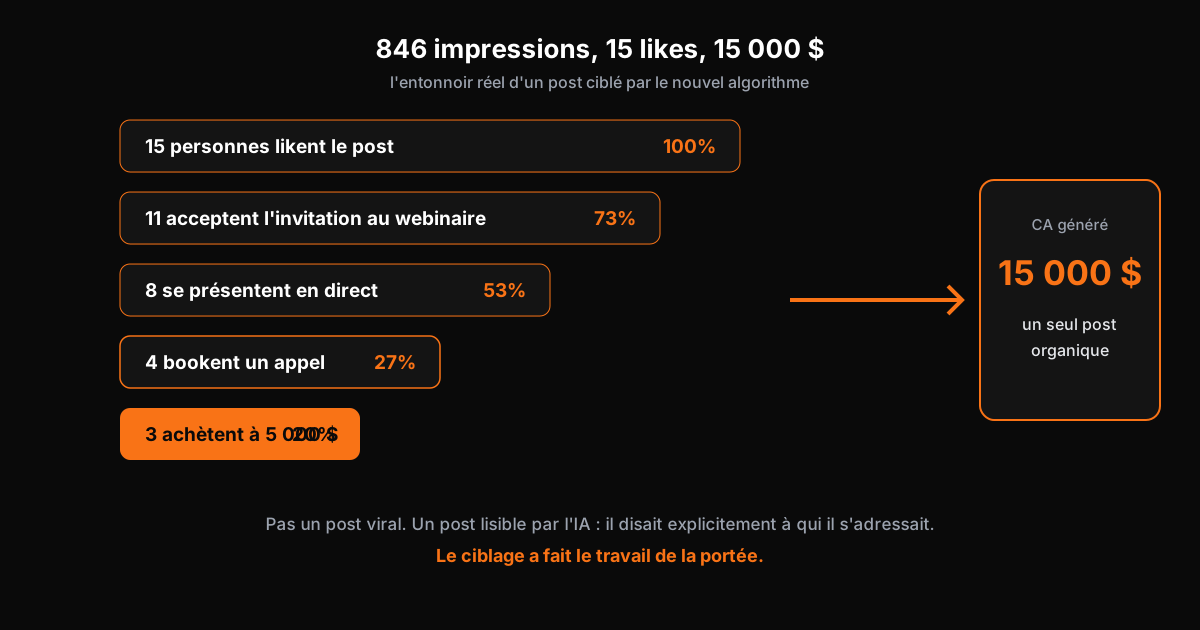
- 15 people liked it.
- 11 accepted the webinar invitation.
- 8 showed up.
- 4 booked a call.
- 3 bought, at $5,000 per offer.
$15,000 generated from one organic post with 846 impressions. The author adds that some of his 200-impression posts also brought in clients. The reason fits in one line: the algorithm had hyper-targeted the right profiles, because the post explicitly said who it was for.
Now compare with the counter-example, from the same author. A meme reposted from Instagram with a caption along the lines of "tell me this isn't real". Hundreds of likes, piles of comments, cascading shares. Business result: zero leads, zero clients, zero dollars. Worse: the flood of out-of-target engagement confused the algorithm about his positioning. His next posts suffered.
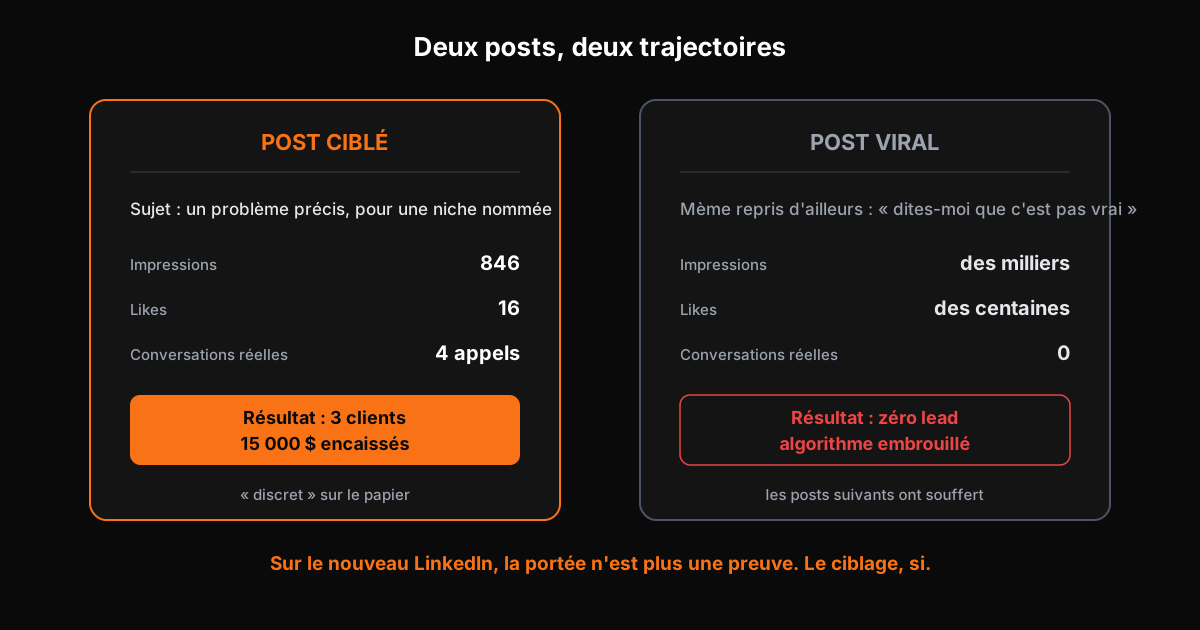
Keep this in mind: on the new LinkedIn, a post that "performs" can hurt you, and a quiet-looking post can fill your pipeline.
Buyers don't like. They read in silence.
This is the most counterintuitive part of the update, and the one that explains why your engagement numbers collapsed while your sales activity didn't follow.
Say you sell consulting to finance leaders. Your target, a CFO, will never like your post on overhauling financial controls. Her peers are watching. Her network is judging. She reads, she closes the tab, she moves on.
Under the old algorithm, that silence was fatal: no engagement, no distribution. The post would die right in front of the only people who could have bought.
The new algorithm no longer works that way. It measures reading time. It can detect that a user stopped on your post, read it through, came back to it. This silent dwell time now counts as much as likes and comments, if not more.
There's a major strategic consequence: follower behavior and buyer behavior are opposites. Followers like, comment, share. Buyers watch from the shadows until a door opens, then move straight through. Publishing without anything behind it collects dead audience. You need a complete capture system behind the content: an aligned profile, a paved conversion path, a way to turn silent reading into conversation.
Your profile is a signal, not a storefront
The AI doesn't just scan your posts. It analyzes your entire profile and crosses everything: profile, content, messages, connections. Every vague element weakens its understanding of your target, and therefore the distribution of your next posts.
The fastest lever is your headline. The formula that works has two parts: who you help, what result you deliver. Nothing else.
Not your degrees. Not your awards. Not "Passionate about digital transformation for 15 years", which tells absolutely nothing to anyone, human or AI.
An effective structure for a business owner: "I help manufacturing SMEs automate quoting and invoicing." Explicit target, explicit result. The machine immediately knows who you're talking to.
How to tell whether the algorithm works for you or against you
Two simple tests, one paid, one free.
Test 1: your profile viewers. A Premium feature. Look at the list of recent visitors. If you target SMB CFOs and the list is full of consultants, students and recruiters, there's a signal problem. If it contains decision-makers from your target market, everything is aligned.
Test 2: your engagement. Free, available to everyone. Open the comments and likes on your last ten posts. Count how many people genuinely match your customer base. Below 50%, the algorithm doesn't understand who you want to reach, and every new post deepens the confusion.
In both cases, the fix is the same: tighten the headline, refocus your topics on a single audience for a few weeks, name your target explicitly in your posts. Effects show fast, within a few publications.
The checklist to apply this week
- Rewrite your headline. Who you help, what result. One sentence, zero jargon.
- Name your target in every post. At least once, literally: "if you run a 20 to 200 employee company...". It's the most direct signal the AI can read.
- Stop chasing virality. A broad post that maps poorly to your niche costs more than it earns. Every off-target post blurs your future distribution.
- Measure something other than impressions. Track profile visits, inbound DMs, conversations started. That's where revenue hides.
- Build the path behind the content. Silent reading, profile visit, first contact: every step must be paved. A post with no destination is a corridor with no door.
The only metric that matters
What the 9-page report boils down to is one inversion: reach used to create clients. Now precision creates clients, and reach follows.
For a B2B SMB owner, this is a historic opportunity. The most powerful distribution machine in B2B now works for free to put your message in front of your buyers, under one condition: your message must be crystal clear, consistent, and systematic.
That's exactly what I build for my clients: content aimed at a single target, agents that catch silent buying signals, and a system that turns a 30-second read into a booked meeting. A Fractional AI Director isn't "doing LinkedIn for you", it's wiring an acquisition machine behind every publication.
A free 45-minute audit to see where your signal is blurry and what the algorithm currently tells your prospects about you. Most companies discover they're talking to everyone, which means talking to no one.
New AI term along the way?
Clear, jargon-free definitions for business leaders.
Take action: your Express AI Audit (45 min)
45 minutes with an AI expert to evaluate your operations, identify productivity gains and map your first high-ROI AI agents.
Designed for SME leaders (10 to 100 staff) · No commitment · 100% IP ownership
Deploy AI Agents in your SME with an External CAIO
Get an outsourced AI Director 1 to 10 days per month to audit, automate your workflows and train your teams.
Stay ahead of AI Innovations
Every week, get a curated selection of our latest articles, case studies, and actionable AI insights directly in your inbox. No spam, 100% value.
Fractional AI Director locations