Best WhatsApp Prospection Tool: 5 Compared
 Gary Bramnik
17 October 2026 · 10 min read
Contents
69 euros a month. 89. 299. Same WhatsApp channel, prices that have nothing in common.
Better question: are you buying a shared inbox, or a salesperson who works for you at night?
I spent a morning going back through the pricing pages of five WhatsApp prospecting tools (checked on October 8, 2026, straight from the official sites that day). The result is clear: on this market, the sticker price tells you almost nothing about what you will actually pay, and tools that look identical on paper have nothing to do with each other in practice.
A disclosure up front: Whatsy is ours. We built it because we could not find what we wanted. The verdict below also tells you where we lose.
The 5 criteria that actually separate WhatsApp tools
Before the tools, let's set the scoring. Five criteria, in this order:
- Real price: the displayed price, what sits on top (seats, conversations, Meta fees), and what it costs to get the serious features.
- Who answers the prospect: a shared inbox a human clicks through, or an agent that qualifies and books the meeting on its own.
- Setup: a QR code in five minutes, or Meta business verification and assisted onboarding.
- Caps: contacts, users, conversations. That is where the bill runs away.
- Scope: WhatsApp only, or a full multichannel platform (email, chat, phone).
Scoop: the market splits into two families. Customer conversation platforms that include WhatsApp (Trengo, Respond.io), and tools where WhatsApp is the product (Whatsy, WATI, Kanal). If you sell to SMEs in prospecting mode, you do not need the first family. If you run a 15-person support desk, you have no reason to take the second.
A word on method, because a comparison without method is propaganda. The prices below come from the official pricing pages, checked on October 8, 2026, in the France configuration where the site offers one. When a vendor shows an annual and a monthly price, I give you both. When a cost depends on volume (Meta fees, active contacts, extra conversations), I flag it instead of hiding it inside an average. No affiliate links, no vendor paid to appear here.
The 5 tools, one by one
Whatsy: the AI agent at the center
Whatsy is our tool, so take the following with the appropriate pinch of salt. It is a WhatsApp prospecting CRM: connect the number by QR code, 13 contact statuses, segmented campaigns, automatic follow-ups at configurable intervals (24, 72, 168h), scoring, reactivation of inactive prospects, and an AI agent that answers 24/7, qualifies and puts the meeting straight into Google or Outlook.
Price, checked on October 8, 2026: Explorer free (interface and read-only CRM, no WhatsApp connection), Starter at 49 EUR/month (one connected account, unlimited messages, 50 contacts max), Growth at 149 EUR/agent/month (250 contacts), Enterprise on request for multiple accounts. Two internal gaps worth noting: the card says 50 contacts while the payment flow shows 100, and a Premium plan at 399 EUR exists in payment but never appears on the pricing page.
We built ours because we wanted a tool that sells, not one that files. A prospect should not feel handled by ticketing software, he should feel he is in a conversation.
- Strength: the lowest entry price in this group with the AI agent included, and setup with no Meta verification.
- Weakness: the contact cap (50 on Starter) and a single WhatsApp account. At volume, that is genuinely short.
WATI: the campaign machine, with a climbing bill
WATI is a WhatsApp Business API provider, with a team inbox, a chatbot builder and broadcast campaigns. It is the default pick when you want large-scale sending across WhatsApp, Instagram and Facebook Messenger.
France prices checked on October 8, 2026: Growth at 69 EUR/month (59 EUR/month on annual equivalent, 708 EUR/year), Pro at 149 EUR/month (1,428 EUR/year), Business at 349 EUR/month (3,348 EUR/year). Growth includes 3 users; extra seats cost 24 EUR on Pro and 69 EUR on Business. And crucially: Meta message fees sit on top of the subscription, and the AI features are paid as separate add-on credits.
Here is where it pinches for a solo consultant or a small business: you pay 69 EUR for a team inbox, not for a salesperson. The qualifying agent is not in the entry price.
- Strength: the official Meta ecosystem, a full 3-user team from 69 EUR, social channels in the same inbox.
- Weakness: AI and messages cost extra, so the real price of automated prospecting is never the one on the pricing page.
Kanal: excellent, but built to sell sneakers
Kanal is a French tool, designed for Shopify and e-commerce: abandoned carts, promotional campaigns, customer follow-ups, an AI agent wired to your product catalogue. The Shopify reviews are excellent, the team is responsive, onboarding is quick.
Prices checked on October 8, 2026: Pro at 89 EUR/month (1 user), Scale at 149 EUR/month (5 users), Business at 350 EUR/month, Agency at 1,900 EUR/month. No commitment. Meta fees apply on top, as everywhere.
The issue is scope, not quality. Kanal thinks in orders, purchase segments and campaign ROI. If you sell a B2B service to company owners, you have no abandoned cart to recover. You have decision makers to qualify.
- Strength: native Shopify integration and clean revenue-per-campaign reporting, from 89 EUR.
- Weakness: built for retail, not for qualifying an owner on a long sales cycle.
Respond.io: the conversation platform, priced per active contact
Respond.io is a conversation management platform: a multichannel inbox (WhatsApp, Instagram, Messenger, Telegram, email, chat, calls), workflows, CRM integrations such as HubSpot and Salesforce, and AI agents that qualify and route.
Prices checked on October 8, 2026: Starter at 79 USD/month billed yearly (948 USD/year), Growth at 159 USD/month, Advanced at 279 USD/month, Enterprise on request. Pricing follows monthly active contacts, and Meta WhatsApp fees apply on top. Important detail: the full AI agent starts at the Growth tier, at 159 USD.
It is solid, mature and built for high-volume B2C teams. But at 159 USD before a single message fee, you are paying for a platform when you may have just wanted a follow-up system.
- Strength: multichannel coverage and CRM integrations, at a scale that holds up.
- Weakness: the AI agent starts at 159 USD/month, and the bill moves with active contacts.
Trengo: the control room for support teams
Trengo is a complete omnichannel inbox: WhatsApp, email, Instagram, Messenger, live chat, SMS and even voice, all shared across the team, with AI agents announced to absorb repetitive questions.
Prices checked on October 8, 2026: Boost at 299 EUR/month billed yearly (349 EUR monthly), Pro at 499 EUR/month yearly (599 EUR monthly), Enterprise on request. Boost includes 10 users and 6,000 conversations per year, Pro includes 20 users and 18,000 conversations. Beyond that, conversations are billed as overage, and AI exchanges are charged separately.
In other words: Trengo sells seats and conversation volume to a structured team. For an SME that wants 40 qualified conversations a month, that is buying a truck to go buy bread.
- Strength: omnichannel depth and team workflow with 10 users included from 299 EUR.
- Weakness: 299 EUR to enter, rigid user packs (10 or 20, nothing in between), and a bill driven by conversations.
The table, in 10 seconds
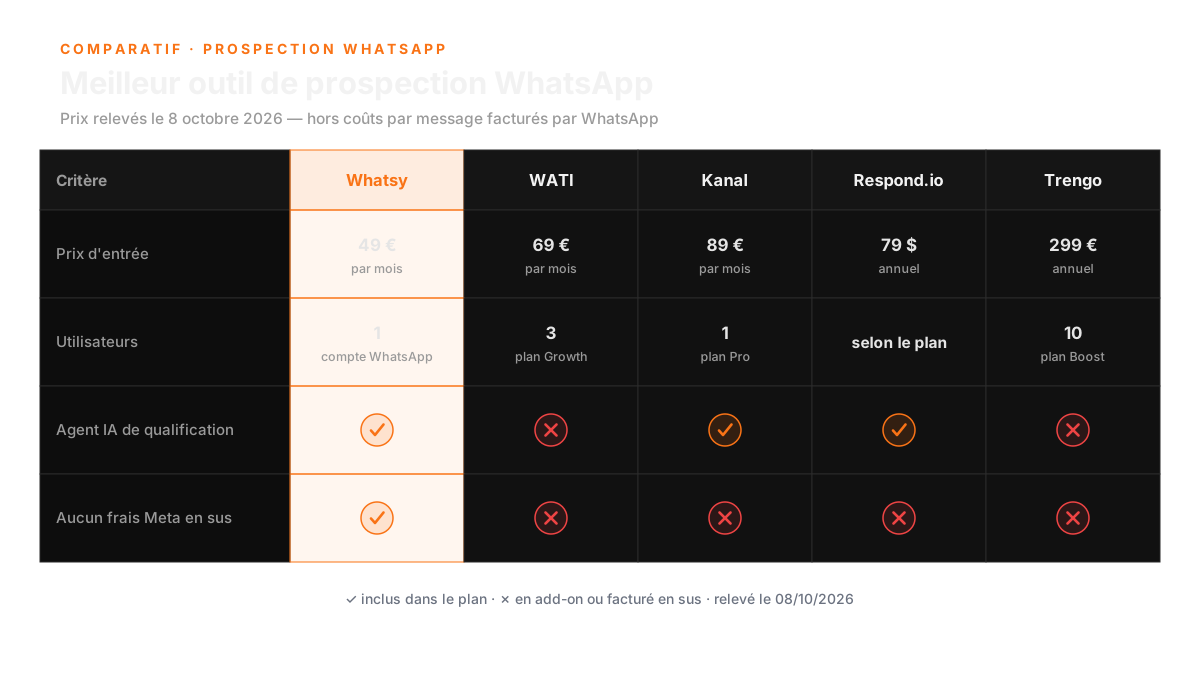
Prices checked on October 8, 2026 on each vendor's official page.
| Criterion | Whatsy | WATI | Kanal | Respond.io | Trengo |
|---|---|---|---|---|---|
| Entry price | 49 EUR/month | 69 EUR/month | 89 EUR/month | 79 USD/month (yearly) | 299 EUR/month (yearly) |
| Next tier | 149 EUR/agent | 149 EUR/Pro | 149 EUR/Scale | 159 USD/Growth | 499 EUR/Pro |
| Qualifying AI agent included | Yes, from 49 | No, AI as add-on | Yes (e-commerce) | From 159 USD | AI agents optional |
| Users | 1 WhatsApp account | 3 (Growth) | 1 (Pro) | Depends on plan | 10 (Boost) |
| Contact cap | 50 (Starter), 250 (Growth) | Based on messages sent | Shopify segments | Monthly active contacts | 6,000 conversations/year |
| Meta fees on top | No (through the connector) | Yes, per message | Yes, per message | Yes, per message | Yes, beyond 1,000 free |
| Multichannel | WhatsApp only | WhatsApp + social | E-commerce WhatsApp | 12+ channels | All channels + voice |
| Setup | QR code, ~5 min | Assisted Meta verification | Shopify app | Structured onboarding | Demo and onboarding |
A word on Meta fees, which are often misunderstood: since late 2025 Meta charges some service messages, and marketing messages are billed per template. With WATI, Kanal and Respond.io those fees run through your account and sit on top of the subscription. Trengo works the same way past the free allowance. With Whatsy, the connection goes through the built-in connector, which keeps the bill simple without making messages free on Meta's side.
FAQ: WhatsApp prospecting tools comparison
What are the main differences between the WhatsApp prospecting tools?
The main differences lie in pricing, whether they offer a shared inbox or an AI agent, the setup process, usage caps, and the scope of services. Some tools focus solely on WhatsApp, while others provide a multichannel platform.
How does Whatsy compare to other tools in terms of pricing?
Whatsy offers the lowest entry price among the compared tools, starting at 49 EUR/month with an AI agent included. However, it has a contact cap of 50 on its Starter plan, which may be limiting for larger businesses.
Are there any hidden costs associated with using WATI?
Yes, while WATI advertises its subscription prices, additional costs can arise from Meta message fees and separate charges for AI features. The real cost can be significantly higher than the displayed subscription price.
The verdict, no beating around the bush
Across the five tools, Whatsy wins three criteria and loses two. That is the kind of table we would have hated to write about a competitor.
We win on entry price. 49 against 69, 89, 79 USD and 299. With the qualifying AI agent inside it, not billed as separate credits. Over the first three months of a trial, the difference pays for your cleanup time.
We win on setup. QR code, number kept, setup claimed at 5 minutes. No Meta business verification, no sales onboarding to schedule.
We win on focus. One objective: turn a WhatsApp number into a meeting. Not a helpdesk, not a twelve-channel platform you configure for three weeks.
We lose on volume. 50 contacts on Starter, 250 on Growth, one single WhatsApp account. If you need to push 2,000 prospects a month across five numbers, look elsewhere: WATI or our own Enterprise tier will serve you better. That is the real ceiling of the tool, and it is deliberate.
We lose on multichannel. If your customers also write by email, website chat and phone, Trengo and Respond.io are objectively better. Whatsy does WhatsApp and nothing else. That is a choice, not an oversight.
We tie on the mid tier. 149 EUR per agent here, 149 EUR at WATI, 159 USD at Respond.io: at that level the tools look alike in price and differ in nature. That is where the choice gets made on usage, not on the range.
We built Whatsy because we kept seeing owners pay 300 EUR a month for a shared inbox while their prospecting died in a spreadsheet. A sales tool should be judged on a single criterion: how many meetings it brings you for what it costs.
If you want to run this table against your own situation, start with our free audit: 45 minutes, we look at your real bottlenecks, and we tell you straight whether a WhatsApp tool is the right answer.
The product lives on whatsy.fr, with a free Explorer plan if you want to test without paying.
And if the real subject is building your whole sales machine, everything is in our lab.
The best WhatsApp tool is the one you open to find meetings, not unread messages.