Best AI LinkedIn Content Tool: 5 Tools Compared
 Gary Bramnik
18 October 2026 · 10 min read
Contents
From 6 to 199 dollars a month. Five tools, one promise: LinkedIn content that ships without you. The real question isn't which one is best. It's which one oversells what it actually does.
I pulled the prices from the official pricing pages on October 8, 2026, in dollars and euros exactly as displayed. Nothing invented, no guessed line item. When a number isn't published, I say so.
The 5 criteria that separate a tool from a gimmick
Before brands, get the criteria straight. Without them you are comparing marketing pages, not software.
1. The real price at sign-up. Not the annual rate pushed in your face, not the small print "starting at". What you pay the first month, every month, with no hidden discount math. This one filters out the most options at first glance.
2. Range depth. Where does the offer stop when you grow? Three tiers? Two? A plan capped at 50 posts when you publish 100? A tool you outgrow in six months costs more than a subscription you cancel while still using it.
3. Billing flexibility. Classic monthly subscription, one-time payment, or open source you self-host. Each of those changes your yearly bill, and changes who carries the maintenance.
4. Material and voice. Does the tool work from what you feed it, your documents, your case studies, the way you turn a sentence, or does it hand back generic text you can find anywhere? This is the only criterion most pricing pages don't document, and it decides whether you still use the tool after three months.
5. Scope. LinkedIn only, or several networks? A multichannel tool helps if you publish elsewhere. It's dead weight if LinkedIn is the only place you show up.
The 5 tools, one by one
Taplio
Taplio is the name that comes up most often when you type "AI LinkedIn content tool" into a search engine. Its pricing page is in dollars: Starter at 39 USD a month, Growth at 69, Pro at 199 a month, with 25% off if you commit for a year.
Three tiers, topping out at 199 USD. By far the priciest offer in this comparison. It's aimed at creators and agencies who live on LinkedIn daily, for whom the subscription is production gear.
Note the discount mechanics: 25% on the annual plan is roughly 50 USD a month saved on Pro. Two schools of thought. Some prefer to write one cheque a year and forget about it, others want to be able to cut a subscription the month activity slows down. Both are right, but they shouldn't pick the same tool.
What those three tiers actually include, the pricing page doesn't spell it all out, and I'm not going to make it up. What I can tell you: at 39 USD to enter, Taplio starts off pricier than the other four tools here.
Strength: the deepest range on the market, up to 199 USD a month. Weakness: the highest entry price in the selection.
ContentIn
ContentIn keeps it simple: two tiers, no more. Growth at 39 USD a month, Pro at 59. On annual billing they drop to 31 and 48 USD a month.
It's the most readable structure in this comparison. Two possible decisions, no twelve-column table to decode on a Sunday night. You only ask yourself one question: does the base plan cover me, or do I want the 59 USD top?
The flip side sits in that second line: the ceiling is 59 USD. The pricing page shows nothing above it. When you grow, you switch tools instead of switching tiers.
The annual saving is real but modest: 8 USD a month on Growth, 11 on Pro. Nothing that justifies a one-year commitment before you've published five times with the tool. Monthly costs a bit more and keeps the door open.
Strength: the clearest positioning, two straightforward prices. Weakness: only two tiers, nothing above Pro.
Postiz
Postiz is a French tool, and it's open source. That's the big difference from the rest: the code is public, and you can self-host it if you'd rather not depend on the vendor's subscription.
On price, four tiers: Standard at 29 USD a month, Team at 39, Pro at 49, Ultimate at 99. On annual billing they fall to 23, 31, 39 and 79 USD a month. After Hypefury, it's the cheapest entry price in this comparison.
Four tiers mean one more decision, but also a growth path with no cliff. You move from Standard to Team without changing tools, then to Pro if volume follows. The first three tiers are tight, 10 USD apart, before the jump to Ultimate.
Self-hosting is a real option, not a slogan: you stop paying the subscription, but you own the server, the updates and the downtime. Great choice if you have technical skills in house, a bad one if you came to publish content, not to administer an instance.
Strength: open source and self-hostable, the only one here. Weakness: the self-hoster becomes their own support desk.
Hypefury
Hypefury attacks from below: 6 USD a month for a Flexible plan covering a single channel, plus 6 USD for each extra channel. Its Full plan goes up to 19 USD a month, all channels included, LinkedIn included.
Translation: 6 USD is the price of a lunch, and that's what it costs to test an idea for a month. The Full plan at 19 USD, around 17 EUR, is still cheaper than any mid tier of the other four tools.
Watch the added-channel mechanics though. At 6 USD per extra channel, three networks cost you 18 USD a month, and the fourth pushes you past the 19 USD Full plan. That's the classic entry offer designed to nudge you into the tier above.
It's also the only tool in this comparison that clearly announces multichannel coverage. If your question is "what does it cost to post on LinkedIn and one more network", Hypefury answers first, and for less money.
Strength: cheapest in the selection, wide channel coverage on Full. Weakness: at 6 USD you get one channel, and the pricing page doesn't detail what the content generation includes.
PostPilote
And finally, ours. PostPilote is an AI French Touch product, priced in euros, with three subscriptions: 19 EUR a month for Décollage, 39 for Altitude, 99 for Horizon.
What structurally separates it from the previous four: the scope is explicit, LinkedIn only, but everything around it is included in the price. The 39 EUR Altitude plan bundles automatic publishing on one LinkedIn account with stats, carousel generation, an unlimited knowledge base and unlimited scraping. The 99 EUR Horizon plan goes to three accounts, with advanced analytics and exports.
Content moves through a four-status pipeline, Idea, Draft, Scheduled, Published, and the AI works from your own documents loaded into the knowledge base. That's the only criterion in this comparison I can document precisely, since it's our product.
There is also a one-time option, lifetime access starting at 99 EUR, whose price rises by 20 EUR every 100 signups. No free offer is displayed on the plans page.
Strength: automatic publishing, carousels, unlimited knowledge base and scraping from 39 EUR, all in euros. Weakness: nothing at 0 EUR to try it, and a strictly LinkedIn scope.
The table, for a 10-second scan
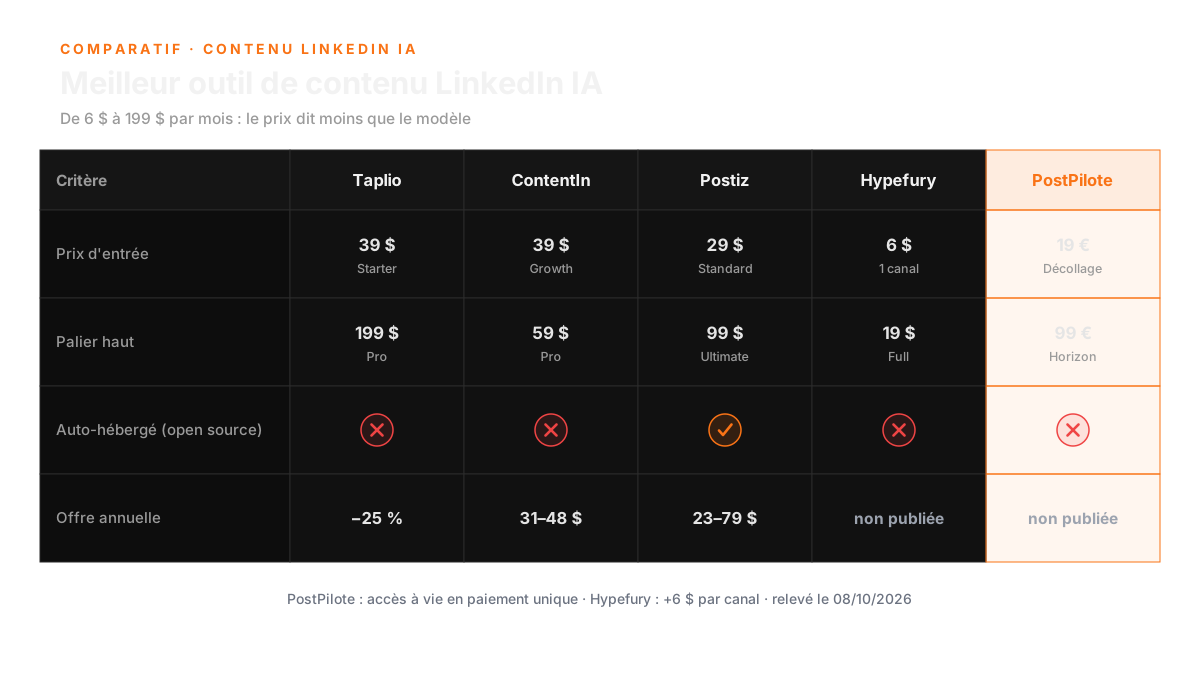
Prices taken from each vendor's official pricing page on October 8, 2026. No annual discount shown other than the ones listed.
| Criteria | Taplio | ContentIn | Postiz | Hypefury | PostPilote |
|---|---|---|---|---|---|
| Monthly entry price | 39 $ | 39 $ | 29 $ | 6 $ | 19 EUR |
| Mid tier | 69 $ (Growth) | 59 $ (Pro) | 39 $ (Team) | 19 $ (Full) | 39 EUR (Altitude) |
| Most expensive tier | 199 $ (Pro) | 59 $ (Pro) | 99 $ (Ultimate) | 19 $ (Full) | 99 EUR (Horizon) |
| Annual offer shown | 25% off | 31 $ and 48 $ | 23 to 79 $ | not published | not published |
| Model beyond monthly | none published | none published | open source, self-hostable | +6 $ per channel | lifetime, one-time payment |
| Free to try | not published | not published | not published | not published | not published |
| Displayed currency | $ | $ | $ | $ | EUR |
The honest verdict
On the five criteria from the start, PostPilote wins three and loses two. That's the real score.
It wins on material and voice. It's the only tool in this selection whose product page documents a knowledge base fed by your own documents. For the other four, the pricing pages don't cover it, and I won't fill that in by assumption.
It wins on mid-tier depth. At 39 EUR you get automatic publishing, carousels, an unlimited knowledge base and unlimited scraping. No other tool in this table advertises that much for the price.
It wins on billing model. A lifetime one-time payment, next to vendors who only offer a monthly subscription.
It loses on price, no discussion. Hypefury charges 6 USD to enter and 19 USD for all its channels. Against that, our 19 EUR entry and 39 EUR mid tier are more expensive. If your only criterion is the smallest budget, take Hypefury, that's the right call.
It loses on scope. Hypefury announces multichannel coverage, we're locked on LinkedIn. If you publish on four networks, this isn't your tool.
Scoop: a comparison that ends with "ours wins everywhere" isn't a comparison, it's a sales page in disguise.
So why did we build our own? Because the whole category charges you for access to a text generator, while the real work sits elsewhere: the raw material, the path from draft to published, consistency over time. We wanted prices in euros, three readable tiers, a pipeline we control, and AI writing from our own files. Nobody was doing it the way we wanted, so we did it.
FAQ: AI LinkedIn Content Tools Comparison
What criteria should I consider when choosing an AI LinkedIn content tool?
You should evaluate the real price at sign-up, range depth, billing flexibility, material and voice quality, and the tool's scope for multiple networks. These factors help you determine the best fit for your needs.
What are the strengths and weaknesses of Taplio?
Taplio offers the deepest range of pricing tiers, starting at 39 USD and going up to 199 USD a month, making it ideal for heavy LinkedIn users. However, it has the highest entry price compared to other tools.
Is there an option for self-hosting with any of these tools?
Yes, Postiz is an open-source tool that allows you to self-host. This gives you control over the server and updates, but requires technical skills to manage effectively.
What I'd do next
Two decisions, in order. First the budget: under 20 USD a month, Hypefury wins, full stop. From 39 EUR, the question becomes what you get for that price, and that's where the comparison comes down to material and automatic publishing.
Second, the mechanics. Whatever tool you pick, it will publish nothing if you give it neither material nor a slot. If you want us to look at your situation, your calendar and your real objective before you spend a euro, book the free 45-minute audit.
If you want the full machine around content, prospecting and automations included, built for you, that's what we build: our lab.
And to judge PostPilote yourself instead of taking my word for it: postpilote.com.
The best LinkedIn content tool is the one you still open six months from now. Everything else is just a pricing page.